
Still, many businesses and consumers don't fully understand what recycled plastic actually is, how it gets made, or what it can (and can't) become. This confusion makes it harder to source materials responsibly or meet growing sustainability expectations.
This guide breaks down the recycling process, the real benefits, common end products, current limitations, and how to vet a recycled resin supplier you can trust.
Key Takeaways
- Post-consumer resin (PCR) comes from recovered household or business plastic waste, not manufacturing scrap
- Recycled HDPE production uses up to 88% less total energy than virgin resin
- Films, bags, PVC, polystyrene, and contaminated plastics are largely excluded from standard recycling programs
- California's SB 54 now drives most current recycled-content compliance requirements for packaging
- PCR-certified, APR-member full-service recyclers deliver the most consistent resin quality
What Are Recycled Plastic Materials?
Recycled plastic materials are plastic scrap that's been collected, sorted, and reprocessed into flake, pellets, or resin so it can be used again in manufacturing. Two source categories define how that material is classified:
- Post-consumer resin (PCR) comes from products already used by households or businesses, then discarded, according to the Association of Plastic Recyclers.
- Post-industrial resin (PIR) comes from manufacturing waste, not from a finished product that reached an end user.
That distinction matters for compliance purposes. If a regulation or brand pledge calls for PCR specifically, PIR material won't satisfy it.
HDPE (High-Density Polyethylene)
HDPE typically comes from milk jugs, detergent bottles, and other rigid containers. Its strength and rigidity make it a natural fit for plastic lumber, pipe, and heavy-duty containers.
LDPE (Low-Density Polyethylene)
LDPE originates from bags, films, and squeeze bottles. Its flexibility suits bags, liners, and other soft packaging applications where rigidity isn't needed.
LLDPE (Linear Low-Density Polyethylene)
LLDPE often comes from stretch film, agricultural film, and other flexible packaging. It adds toughness and puncture resistance, so it shows up in bags, liners, and film applications that need more durability than standard LDPE.
PET (beverage bottles) and PP (yogurt tubs, bottle caps) are also widely recycled, though each follows different sorting and processing paths.
PPP, LLC focuses on HDPE, LDPE, and LLDPE resin—supplying pellets customized for size, shape, color, finish, and performance to match a manufacturer's spec sheet.
How Plastic Recycling Works: From Bin to Resin
Turning scrap plastic into usable resin isn't a single step. It's a multi-stage process where quality control at each phase determines whether the final pellets are usable at all.
- Collection - Curbside bins or community drop-off points gather household and commercial plastic waste
- Hauling to a MRF (Material Recovery Facility) - Collected material is trucked in for initial processing
- Sorting - Optical sorters and manual quality-control staff separate plastic by resin type, then bale it for sale
- Second sort - Recyclers cut open bales and run another pass to pull out glass, metal, and other contaminants
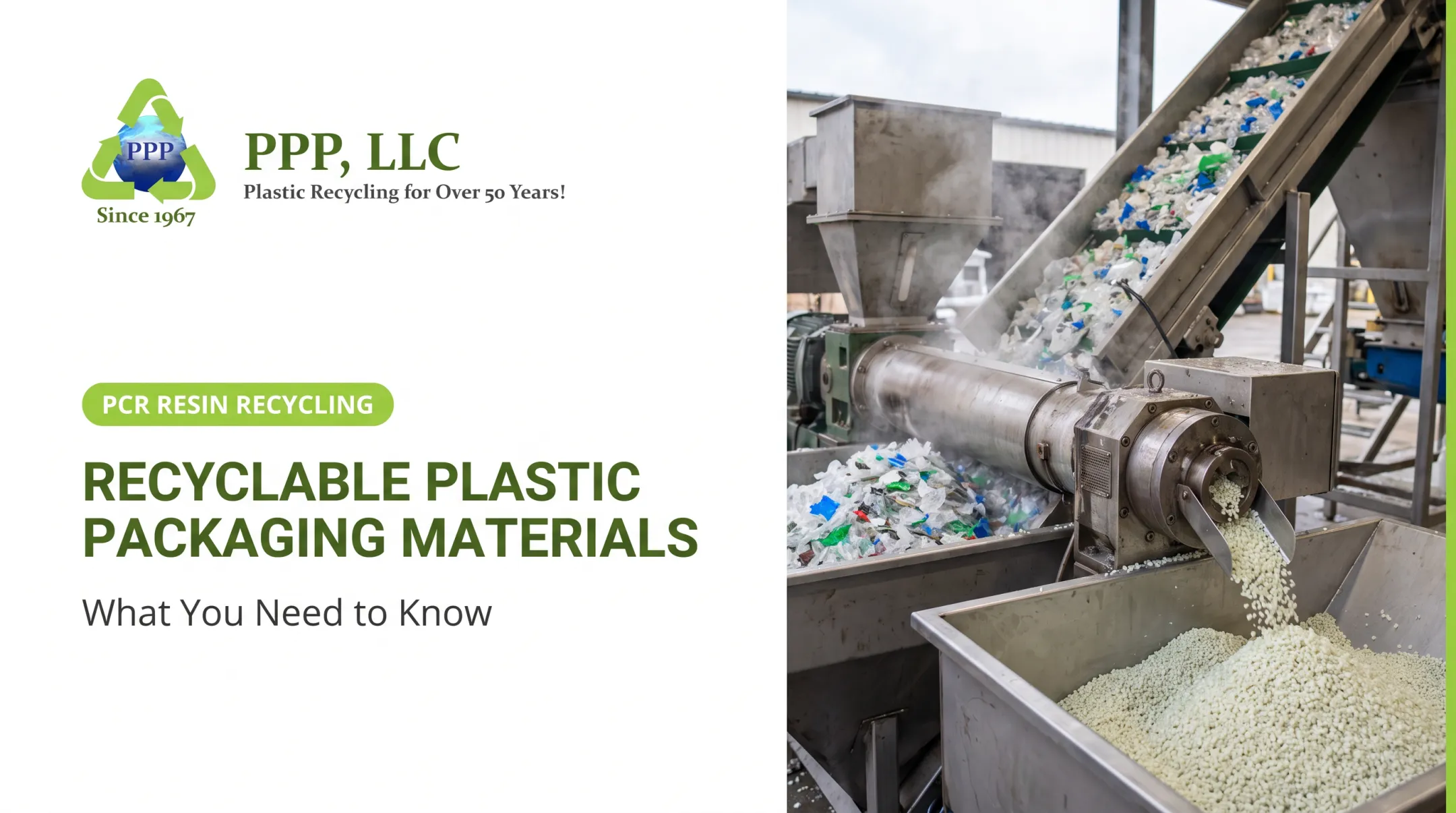
- Grinding and washing - Sorted plastic is shredded into flake, washed, then floated or sunk in water tanks to isolate specific resin types
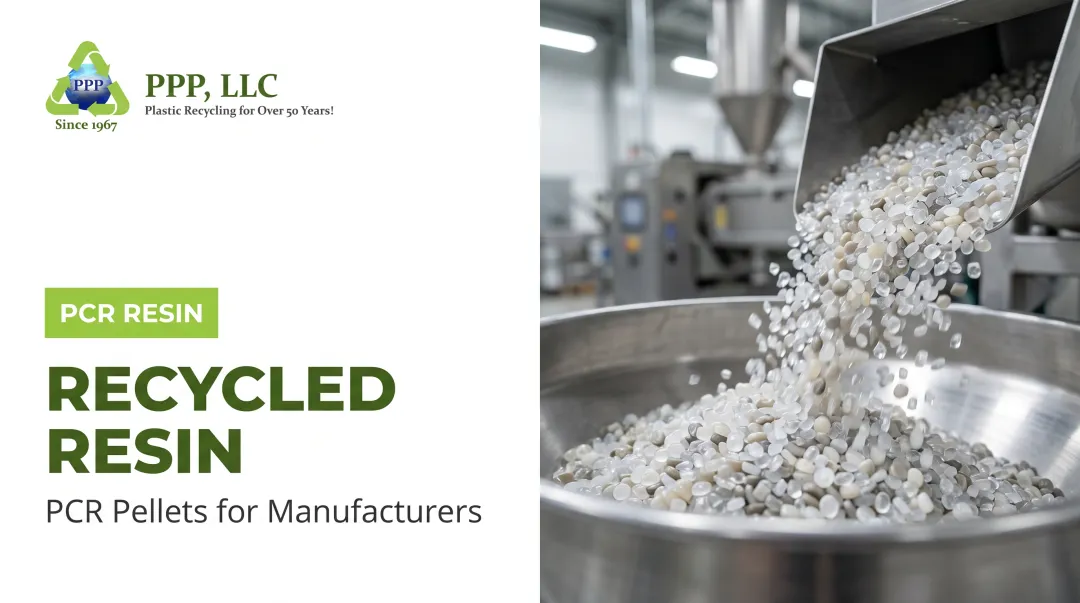
- Melting and pelletizing - Clean flake is melted, filtered to remove remaining solids, and formed into resin pellets ready for manufacturing

Scale and specialization matter most in those final stages. PPP, LLC has spent over 50 years refining grinding and pelletizing for HDPE and LDPE scrap. The company converts both purchased material and customer-owned scrap through toll processing into resin that manufacturers can drop directly into production lines.
Done well, the energy payoff is large. A 2018 life cycle analysis by the Association of Plastic Recyclers and Franklin Associates compared recycled HDPE with virgin resin:
- 88% less total energy under cut-off allocation (44% under open-loop)
- 71% lower global warming potential under cut-off allocation (35% under open-loop)
Why Recycled Plastic Materials Matter
The case for recycled plastic isn't just environmental. It touches cost structure, brand positioning, and legal exposure all at once.
The Environmental Case
Every pound of recycled resin is a pound that didn't need new petroleum extraction, and a pound that stayed out of a landfill.
The EPA reports that 27 million tons of plastic were landfilled in the U.S. in a single recent year, according to its materials and waste data. Diverting even a fraction of that volume into resin production eases landfill pressure and cuts reliance on non-renewable fossil feedstock.
The Business Case
Recycled resin delivers clear commercial upsides:
- Often costs less than virgin material
- Supports documented zero-waste or sustainability claims that resonate with eco-conscious buyers
- Lets manufacturers recover value from their own scrap through toll processing, without buying grinding or pelletizing equipment
The Regulatory Case
California has moved aggressively on recycled-content rules, though not every proposal became law:
- Assembly Bill 478 proposed minimum PCR thresholds for thermoform containers but did not pass into law
- Senate Bill 270 once required recycled content in reusable grocery bags, though those specific provisions are no longer in effect
- Senate Bill 54, the state's current packaging framework, requires producers to hit escalating recycled-content and reduction targets, with permanent rules detailed on CalRecycle's SB 54 regulations page
Regulations like SB 54 only work when certified recycled resin is available to meet them. Demand-side choices—from governments, brands, and consumers—are what keep the recycling supply chain financially viable. Without buyers for recycled content, sorting and processing facilities have no reason to exist.
What Items Can Be Made From Recycled Plastic?
Recycled plastic—especially HDPE and LDPE—shows up in far more finished goods than most people expect. Brands and OEMs use post-consumer resin (PCR) to meet content rules, cut virgin resin use, and hit durability specs.
Packaging & Containers
Food, consumer, and industrial packaging are prime outlets for PCR as state recycled-content rules tighten:
- Bottles, jugs, and tubs
- Films, wraps, and retail bags
- Food, pharma, and electronics packaging components
Construction & Building Materials
Outdoor and moisture-prone builds favor recycled HDPE and LDPE for long service life:
- Plastic lumber and decking
- Composite building panels
- Outdoor profiles and site furnishings
Consumer & Home Goods
Homes and commercial interiors use recycled plastic as fiber or sheet stock:
- Carpeting and carpet backing
- Countertops and solid-surface blanks
- Flooring tiles and underlayment layers
Fibers, Nonwovens & Soft Goods
Beyond rigid parts, reprocessed polyethylene supports fiber-style and soft-good applications in durable everyday products:
- Nonwoven fabrics and industrial wipes
- Woven bags and bulk sacks
- Outdoor gear components and accessories
Irrigation, Bags & Industrial OEM Uses
Spec-driven manufacturers buy PCR pellets to feed high-volume lines—not as a marketing extra, but as a qualified material input. PPP, LLC supplies PCR resin used in bag and film lines, food and pharmaceutical packaging, electronics packaging, and irrigation components.

What Types of Plastic Can't Be Recycled?
Not every plastic item belongs in a curbside bin, and putting the wrong material in the wrong stream causes real problems downstream.
- Flexible films and plastic bags wrap around and jam Materials Recovery Facility (MRF) sorting equipment, so they don't belong in curbside bins. Use grocery-store or retailer drop-off points instead.
- PVC (#3) and polystyrene (#6) are rarely accepted in residential programs. Processing infrastructure is limited, and demand for the reclaimed material stays weak.
- Contaminated, multi-layer, or mixed-material plastics—food-soiled containers, laminated pouches, and similar items—are often rejected because the layers can't be cleanly separated.
A single stray PVC item can compromise an entire batch of recycled HDPE, because PVC degrades at temperatures below normal HDPE processing heat. Clean upstream sorting protects batch quality as much as any downstream equipment upgrade.
Choosing the Right Recycled Resin Partner
Not all recycled resin suppliers deliver the same consistency. A few credentials separate the reliable partners from the rest.
Look for these two things first:
- PCR certification with annual re-certification — Confirms real post-consumer content claims and ongoing review, not a one-time audit
- Active APR membership — Shows ongoing engagement with Association of Plastic Recyclers standards and regulatory changes
Beyond credentials, full-service capability matters just as much. A recycler that handles grinding, pelletizing, and reprocessing under one roof can hold quality on size, shape, color, finish, and performance. Handing material off between vendors only adds chances for contamination or spec drift.
PPP, LLC is built around that model: a full-service, PCR-certified, APR-member facility with over 50 years of HDPE, LDPE, and LLDPE processing experience. Manufacturers across California, Arizona, and the broader U.S. use PPP for custom resin specs and practical guidance on rules like SB 54.
Frequently Asked Questions
What items can be made out of recycled plastic?
Recycled HDPE and LDPE go into packaging, construction materials like decking and lumber, textiles, home goods such as carpeting, and industrial products including irrigation components.
What types of plastic usually can’t go in curbside recycling?
Flexible films and bags, PVC, polystyrene, and contaminated or multi-layer plastics are usually left out of curbside programs. Specialized industrial recyclers can still process many PE films and bags into PCR resin.
What is PCR (post-consumer recycled) resin?
PCR resin is plastic reclaimed from products already used by consumers or businesses, then reprocessed and certified for reuse in new manufacturing applications.
Is recycled plastic as durable as virgin plastic?
Properly processed and certified recycled resin can meet the same performance specifications as virgin plastic for many applications, though each grade should be validated for its specific intended use.
How does California's SB 54 affect businesses that use plastic packaging?
SB 54 phases in stricter recycled-content, recyclability, and source-reduction rules for packaging producers through 2032. Meeting those targets depends on steady access to certified PCR supply.
What's the difference between recycling HDPE and LDPE?
HDPE is rigid and strong, suited for bottles and lumber, while LDPE is flexible, making it better for bags and film packaging. Both require separate sorting and processing streams.