
Manufacturers and packaging companies face a real challenge here. Choosing between HDPE, LDPE, LLDPE, and their many sub-grades affects product performance, cost, and increasingly, regulatory compliance. Add sourcing decisions between virgin and recycled resin into the mix, and material selection gets complicated fast.
This guide breaks down what polyethylene resin actually is, how it's made, the differences between resin grades, and where recycled PCR resin fits into a compliant, sustainable supply chain.
Key Takeaways
- Polyethylene leads global plastics output—ethylene gas polymerized into long chains that become HDPE, LDPE, and LLDPE
- Catalyst choice and process conditions set density and branching, which lock in grade and performance
- Match the grade to the job: HDPE for rigid jugs, LLDPE for stretch film, specialty resins for medical use
- PCR resin can match virgin performance while cutting energy use and emissions versus new resin
- California rules such as SB 54 now drive recycled-content sourcing and reporting for manufacturers
What Is Polyethylene Resin?
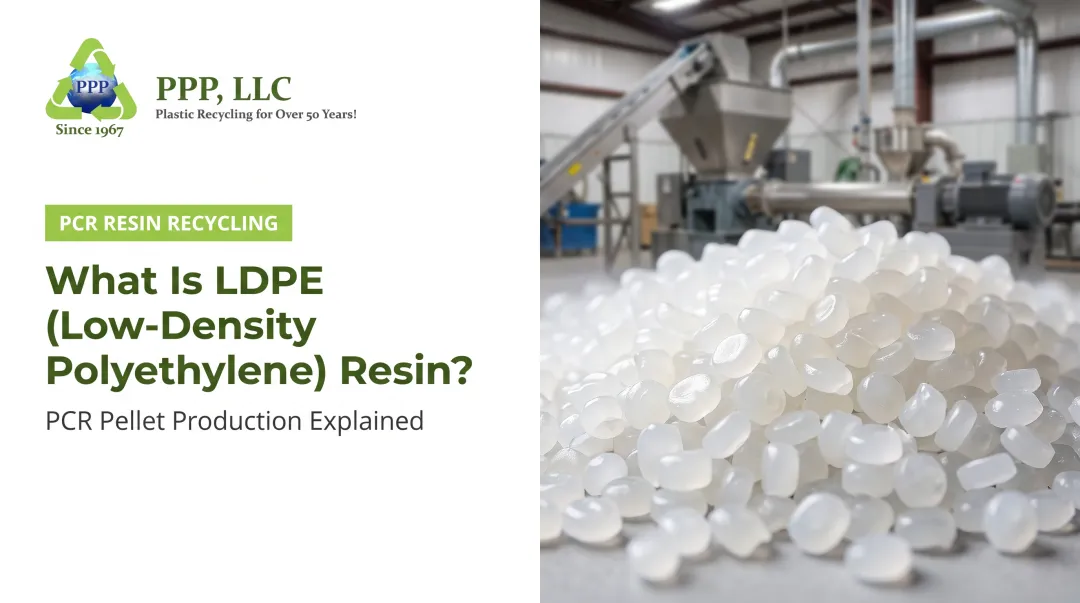
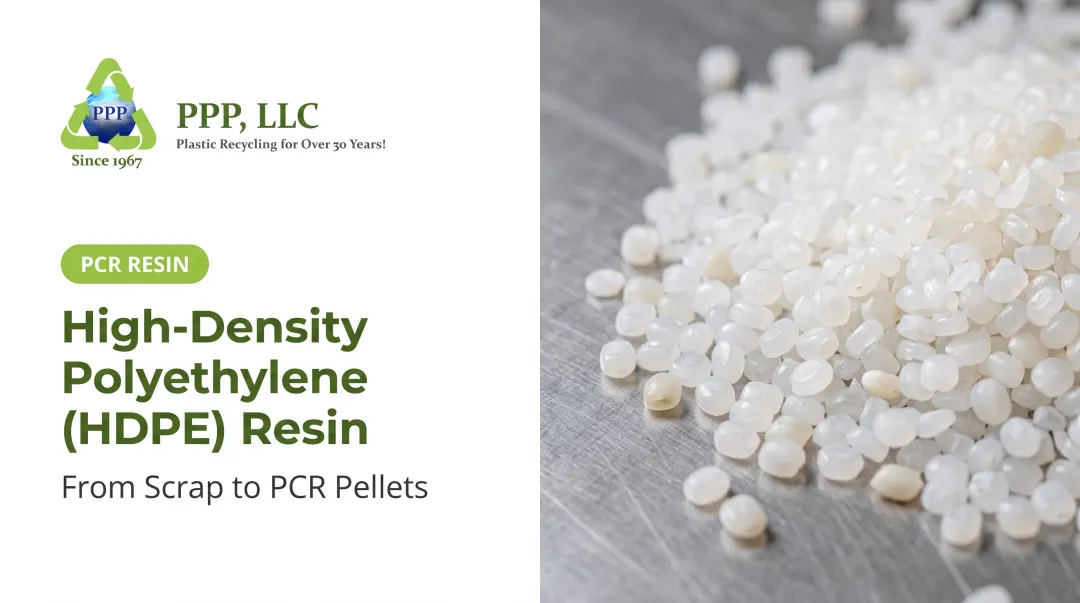
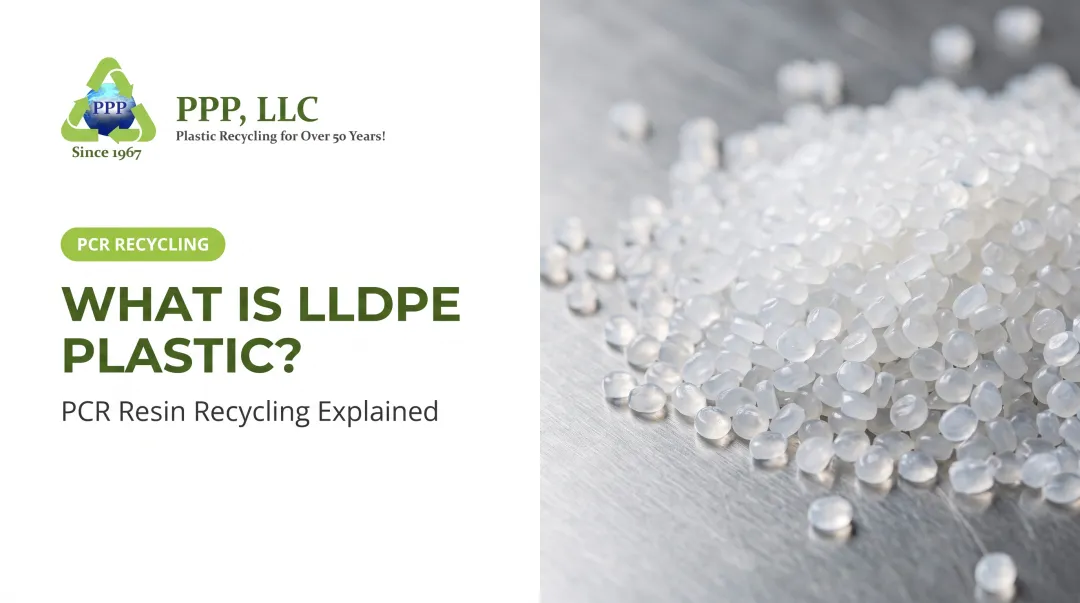
Polyethylene resin is a thermoplastic polymer built from repeating ethylene (C2H4) monomer units chained together during polymerization. Manufacturers receive it in small pellet form, often called "nurdles," which they melt and mold into finished products like bottles, bags, and pipes.
That pellet form matters. "PE resin" refers specifically to this raw manufacturing input, not the finished plastic item sitting on a store shelf. Those pellets can come from virgin polymerization or from post-consumer recycled (PCR) streams that reprocess scrap back into specification resin.
Physical and Chemical Properties
Polyethylene's properties vary widely by grade, but a few characteristics hold true across the family:
- Density range: HDPE runs 0.93 to 0.97 g/cm³, while LDPE sits lower at 0.910 to 0.940 g/cm³, per PlasticsEurope's polyolefins data
- Chemical resistance: Strong resistance to most acids and bases, making it suitable for chemical storage
- Water absorption: Near zero, which helps explain its dominance in packaging and outdoor applications
- Electrical properties: Excellent insulator, widely used in cable coatings and wire jacketing
- Optical properties: Ranges from transparent (thin LDPE film) to opaque (thick HDPE containers)
Those same traits—light weight, toughness, and chemical stability—are why polyethylene moved so quickly from lab curiosity to industrial staple.
From Accidental Discovery to Industrial Staple
Polyethylene wasn't invented on purpose. German chemist Hans von Pechmann first observed it as a strange, fluffy white residue in 1898 while running an unrelated experiment. It took until 1933 for ICI in England to achieve the first practical industrial production, using high-pressure conditions that would later define the LDPE manufacturing process still used today.
How Is Polyethylene Resin Made?
Polyethylene production starts with hydrocarbon feedstock and ends with pellets ready for a manufacturer's hopper. The path between those two points depends heavily on which resin grade you're targeting.
From Feedstock to Ethylene Gas
Refiners crack hydrocarbon feedstocks under intense heat to release ethylene monomer. That feedstock is either naphtha (from crude oil) or ethane (from natural gas), fed into steam crackers that split the molecules into ethylene gas.
Polymerization: Pressure Paths and Reactor Systems
Once ethylene gas is available, the production route splits based on the target resin:
- High-pressure radical polymerization produces LDPE, creating a highly branched molecular structure that gives the resin its flexibility and clarity.
- Low-pressure catalytic polymerization uses Ziegler-Natta or Phillips-type chromium oxide catalysts to produce HDPE and LLDPE, resulting in linear chains that pack tightly for greater strength and rigidity.
Manufacturers run catalytic polymerization through one of three reactor systems:
- Slurry (loop) process – suspends catalyst and polymer in a liquid diluent
- Solution process – dissolves the polymer in a solvent at higher temperatures
- Gas-phase process – polymerizes ethylene directly in a fluidized bed reactor
Reactor choice shapes particle form, molecular weight distribution, and production efficiency.

Finishing Steps
Raw polymer powder doesn't ship as-is. Producers extrude it into uniform pellets, blend in stabilizers and additives, then run quality control tests, including melt flow rate, density, and molecular weight, before the resin ever reaches a manufacturing facility.
Types of Polyethylene Resins and Their Properties
Not all polyethylene behaves the same way. Molecular structure, specifically how much branching occurs and how tightly chains pack together, determines whether a resin grade works better for a rigid pipe or a flexible bag.
HDPE (High-Density Polyethylene) packs densely (0.93-0.97 g/cm³) with minimal branching, giving it high tensile strength. Common uses include milk jugs, detergent bottles, and pressure pipe.
LDPE (Low-Density Polyethylene) carries heavy branching that keeps chains loosely packed, producing a flexible, often transparent material. You'll find it in plastic bags, squeeze bottles, and film wrap.
LLDPE (Linear Low-Density Polyethylene) combines a linear backbone with short branches, delivering superior puncture and tear resistance compared to standard LDPE. It's the go-to choice for stretch film and heavy-duty bags.
Specialty grades fill narrower niches:
- MDPE bridges HDPE and LDPE properties, used in gas pipes and shrink film
- UHMWPE (Ultra-High Molecular Weight Polyethylene) offers exceptional wear resistance, used in medical implants, bearings, and high-wear industrial parts
| Resin Type | Density | Flexibility | Typical Use |
|---|---|---|---|
| HDPE | 0.930–0.970 g/cm³ | Rigid | Bottles, pipes, containers |
| LDPE | 0.910–0.940 g/cm³ | Highly flexible | Bags, film wrap, squeeze bottles |
| LLDPE | 0.915–0.930 g/cm³ | Flexible with strength | Stretch film, heavy-duty bags |
| MDPE | 0.926–0.940 g/cm³ | Semi-flexible | Gas pipes, shrink film |
Common Applications of Polyethylene Resins
Polyethylene's versatility shows up across nearly every industry that handles packaging or fluid transport.
Packaging remains the largest use category:
- Bags, films, and shrink wrap for retail and food products
- Bottles and jars for beverages, household chemicals, and personal care items
- Pharmaceutical packaging requiring precise barrier properties
Industrial and agricultural applications lean on polyethylene's durability:
- Water and gas distribution pipes
- Drum liners for chemical and food-grade storage
- Irrigation tubing and agricultural components
Consumer and specialty products include:
- Toys and household goods
- Cable insulation
- UHMWPE fiber for high-strength ropes and protective gear
Across these markets, manufacturers specify HDPE, LDPE, and LLDPE—including post-consumer recycled grades that partners such as PPP, LLC supply for bags, packaging, and irrigation components.
Virgin vs. Recycled (PCR) Polyethylene Resin
Virgin polyethylene relies entirely on non-renewable petroleum feedstock. The cracking and polymerization steps required to produce it carry a real carbon cost, one that compounds as global production climbs toward half a billion metric tons a year.
Recycled resin offers a different path. The Association of Plastic Recyclers' 2018 life cycle study found that recycled HDPE uses 88% less total energy and generates 71% fewer greenhouse gas emissions than virgin HDPE production. That gap matters because well-processed PCR can still meet performance needs in many finished products.

Virgin vs. PCR at a glance:
- Feedstock: Petroleum-based monomers vs. recovered HDPE/LDPE scrap
- Energy and emissions: Far lower for PCR (88% less energy, 71% fewer GHGs for HDPE)
- Best fit: Virgin for the tightest spec-critical uses; PCR where sustainability and compliance goals matter alongside performance
How PCR Resin Gets Made
Post-consumer recycled resin doesn't happen by accident. It requires a controlled process:
- Sourcing and sorting – Collect and qualify HDPE and LDPE scrap from jugs, bottles, film, bags, and other packaging
- Grinding and shredding – Reduce material into flakes or granules
- Washing – Clean flakes to remove contaminants, labels, and adhesive residue
- Melting and extrusion – Melt cleaned material and run it through an extruder
- Pelletizing – Form extruded output into finished resin pellets ready for manufacturing
PPP, LLC has run this process since 1967. As a PCR-certified APR member facility, it buys post-industrial and post-consumer HDPE and LDPE scrap from manufacturers, processors, converters, and recycling partners.
PPP then grinds, washes, and pelletizes that scrap into resin matched to customer specs for size, shape, color, and performance.
PPP also offers toll processing, where customers retain ownership of their own scrap while PPP handles the grinding, washing, extrusion, and pelletizing. This lets manufacturers recover material value without building out their own recycling infrastructure. Both models can yield recycled resin that meets performance requirements comparable to virgin material—while cutting energy use and emissions.
Environmental Impact and Regulatory Compliance
Polyethylene carries two recycling identification codes: HDPE is #2, and LDPE is #4. Both are widely accepted in curbside and commercial recycling programs, but polyethylene does not biodegrade naturally. Collection and reprocessing infrastructure determine whether it returns to the supply chain or goes to a landfill.
California rules that affect polyethylene packaging and bags include:
- SB 270 required reusable plastic grocery bags to contain 20% PCR content, rising to 40% after January 1, 2020 (requirements that applied through the post-2020 period)
- AB 478 proposed tiered PCR requirements for thermoform containers starting at 10%, but the bill never became law and died in 2022
- SB 54 now serves as the operative framework, setting recycling rate targets of 30% by 2028, 40% by 2030, and 65% by 2032, alongside source-reduction requirements reaching 25% by 2032

Manufacturers subject to SB 54 reporting need documented, traceable recycled content data. A PCR-certified partner such as PPP, LLC—with quarterly reviews and annual re-certification—provides the traceable documentation trail manufacturers need for regulatory reporting and customer-facing zero-waste commitments.
Frequently Asked Questions
What is polyethylene resin?
Polyethylene resin is a thermoplastic polymer made from repeating ethylene monomer units, supplied to manufacturers as small pellets. These pellets get melted and molded into finished plastic products like bottles, bags, and pipes.
What is polyethylene used for?
Polyethylene is used in packaging (bags, films, bottles), industrial piping (water and gas distribution), and consumer goods (toys, cable insulation, containers). Its specific use depends on the resin grade and its density and flexibility profile.
What's the difference between HDPE and LDPE?
HDPE has a denser, more linear molecular structure (0.93-0.97 g/cm³), giving it rigidity for bottles and pipes. LDPE has heavy branching and lower density (0.910-0.940 g/cm³), making it flexible enough for bags and film wrap.
Is polyethylene resin recyclable?
Yes. HDPE (#2) and LDPE (#4) are both widely recyclable, though local collection programs vary. Check what your municipality accepts curbside.
What is PCR (post-consumer recycled) resin?
PCR resin is post-consumer plastic scrap that's been sorted, washed, melted, and reformed into pellets meeting manufacturing-grade specifications. It performs comparably to virgin resin while requiring far less energy to produce.
How do I choose the right polyethylene resin for my application?
Consider flexibility needs, strength requirements, and sustainability goals. A packaging line needing puncture resistance might favor LLDPE, while a manufacturer targeting recycled-content goals should discuss PCR HDPE or LDPE options directly with a supplier like PPP, LLC.