
Introduction
Every day, factories trim excess film from packaging lines, warehouses toss out damaged pallet wrap, and retailers return truckloads of shrink-wrapped inventory. Most of that plastic never touches a household recycling bin.
Businesses generate an enormous share of the plastic waste stream, yet a lot of it is clean enough, and concentrated enough, to become raw material again. The catch: the U.S. only recycles a fraction of what it collects.
Research from the National Institute of Standards and Technology found that just 7.9% of plastic waste actually gets recycled after accounting for sorting losses and contamination, even though about 15% gets collected in the first place.
This article breaks down what commercial plastics recycling actually involves, how the process works step by step, which resins make the cut, and the California regulations pushing manufacturers toward certified recycled content.
Key Takeaways
- Commercial recycling turns business plastic scrap into post-consumer recycled (PCR) resin ready for manufacturing
- Grinding and pelletizing are the two mechanical steps that convert raw scrap into usable pellets
- HDPE and LDPE dominate commercial streams because of their purity and steady market demand
- California's evolving recycling laws increasingly require manufacturers to document verified recycled content
- Working with a PCR-certified, APR-member facility protects both resin quality and legal compliance
What Is Commercial Plastics Recycling?
Commercial plastics recycling is the collection, processing, and repurposing of plastic waste generated by businesses and industrial operations, not households. Think production offcuts from a bag manufacturer, damaged packaging from a distribution center, or bulk post-consumer bottles gathered by a retailer.
The reclaimed material moves through one of two paths:
- Closed-loop recycling: scrap is reprocessed back into the same category of product, such as HDPE milk bottles becoming new HDPE bottles
- Open-loop recycling: the resin gets a second life in a different application, like HDPE bottles turning into irrigation pipe

PPP, LLC has worked exclusively in this space since 1967, buying HDPE and LDPE scrap from manufacturers, processors, and converters, then converting it into PCR resin that feeds right back into packaging, bag, and agricultural production.
Over five decades, the company has supported both models, sometimes returning resin to the same manufacturing partner and sometimes supplying it into entirely new industries.
Commercial vs. Residential Recycling
The gap between commercial and residential streams comes down to volume and consistency:
- Commercial streams are typically single-resin, sourced directly from a known supplier, and arrive with far less mixed contamination
- Residential streams pass through curbside bins and municipal sorting facilities, where bottles, film, paper, and food residue all mix together
That said, commercial material isn't automatically cleaner. A Portland-area study of more than 38,000 pounds of commercial loads still found 14% average contamination, driven largely by a handful of poorly sorted loads.
The real advantage of commercial recycling is logistical: businesses can negotiate direct sourcing agreements with recyclers instead of relying on curbside pickup and public sorting infrastructure. That direct relationship is what lets a recycler like PPP verify resin type and quality before material ever reaches the grinder.
The Commercial Plastics Recycling Process
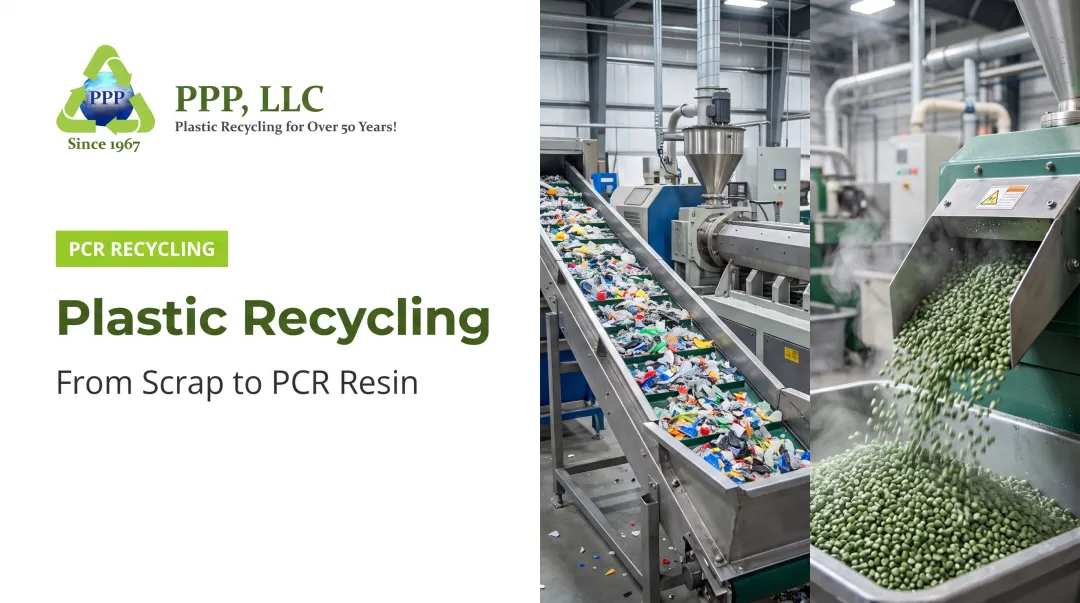
Turning business scrap into usable resin involves a defined sequence of mechanical and thermal steps. Skipping any one of them compromises the quality of the final pellet.
- Collection & sourcing — Bring in production offcuts, packaging waste, and bulk post-consumer plastic through purchase agreements or toll processing arrangements.
- Sorting & identification — Separate plastics by polymer type using resin identification codes (RIC 1–7), then pull out metal, paper, and incompatible resins.
- Grinding — Shred sorted scrap into flake. APR quality screening often references natural HDPE flake around 3/8-inch, though output varies by equipment.
- Washing & cleaning — Wash flake with hot water and detergent to strip labels, adhesives, and residue, then rinse and dry.
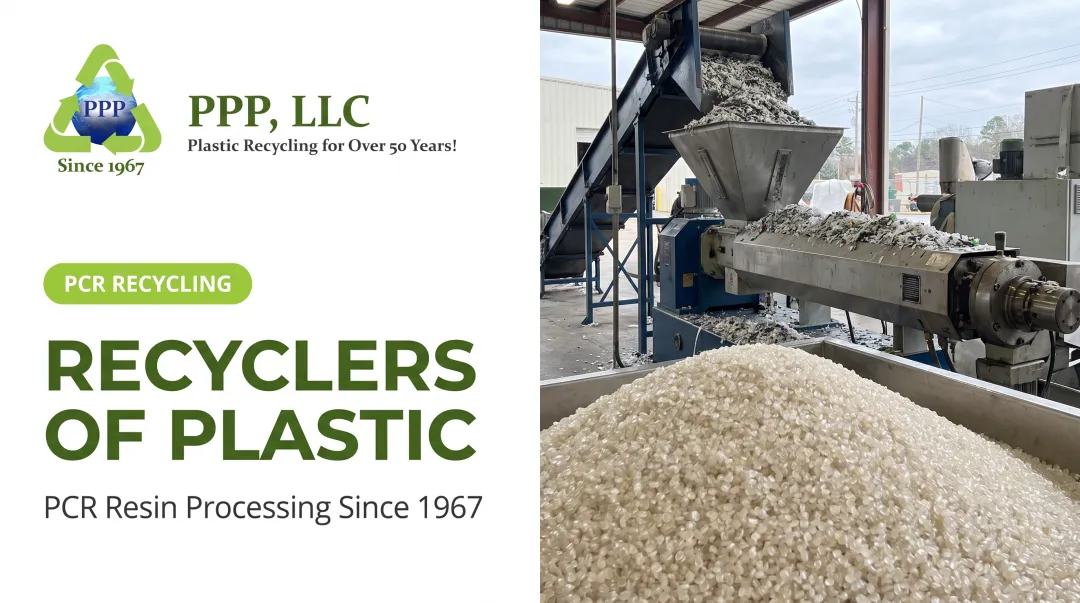
- Pelletizing — Melt clean, dry flake, extrude and filter it, then cut it into uniform pellets.
- Reintroduction to the supply chain — Sell finished PCR pellets to manufacturers producing bags, packaging, and irrigation components.

PPP runs the same sequence in-house: sourcing, sorting, shredding, washing, extrusion, and pelletizing.
For companies that want scrap returned as resin instead of selling it outright, PPP also offers toll processing. Customer-owned HDPE and LDPE is converted into pellets while ownership stays with the customer—a closed-loop path for manufacturers with steady scrap volume who don't want to build their own recycling line.
Types of Plastics Recycled Commercially
Not every plastic is worth reclaiming. Resin chemistry, contamination risk, and market demand all determine what's actually viable at commercial scale.
Commonly Recycled Commercial Plastics
HDPE (Resin Code 2) shows up in bottles, containers, and heavy-duty bags. Its rigid structure and chemical stability make it one of the most reliable resins to reprocess.
Steady manufacturer demand keeps HDPE among the more consistently marketable materials in the recycling stream.
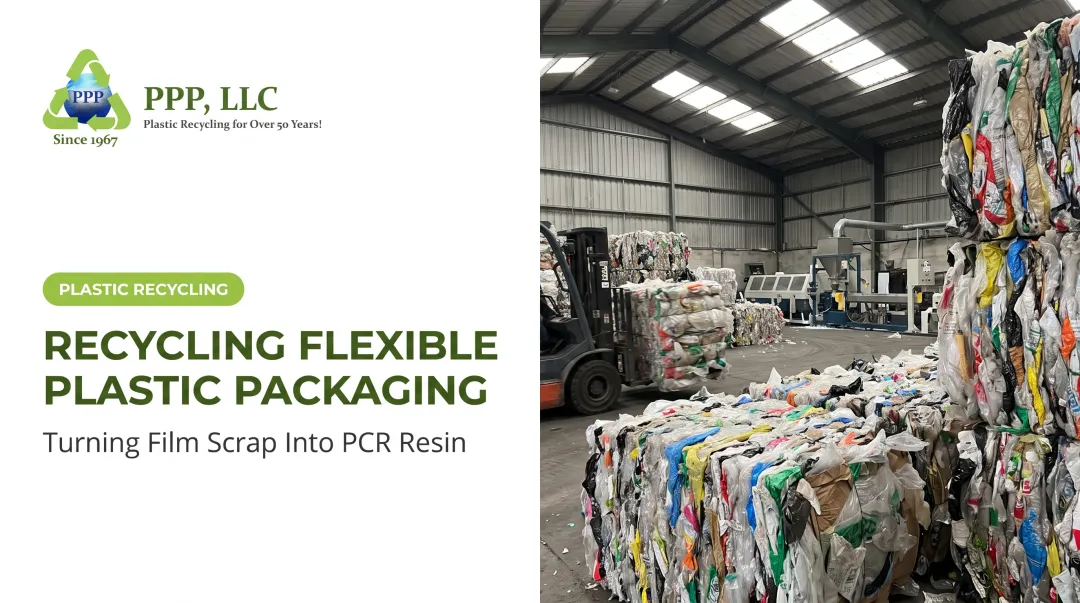
LDPE (Resin Code 4) dominates films and flexible packaging, from shrink wrap to retail bags.
Commercial LDPE recovery has grown significantly—the Association of Plastic Recyclers reported over 1.3 billion pounds of film recovered in the U.S. in 2024 alone.
PET (Resin Code 1) posts strong recovery rates in both commercial and residential streams, largely thanks to established beverage-bottle collection infrastructure. It sits outside the polyethylene focus (HDPE, LDPE, and LLDPE) that defines most commercial film and rigid reprocessing programs.
Plastics That Cannot Be Recycled Commercially
Some resins simply don't hold up to reprocessing at scale:
- PVC (Resin Code 3) — can release hydrochloric acid and chlorine when melted alongside other polymers, contaminating entire batches
- Polystyrene (Resin Code 6) — has extremely limited market demand and a systemwide recycling rate under 1%
- Multilayer/composite plastics — combine foil, paper, or mixed polymers that can't be separated economically and throw off sorting equipment
Manufacturers can sidestep these dead ends by following the APR's Design Guide for Plastics Recyclability, which has set packaging design benchmarks since 1994.
Benefits of Commercial Plastics Recycling
Commercial plastics recycling delivers value on three fronts: environmental, financial, and supply chain.
Environmental impact. Producing resin from recycled HDPE cuts total energy use by roughly 88% compared to virgin resin production, according to a life-cycle assessment conducted for the Association of Plastic Recyclers. That same study found a 71% reduction in greenhouse gas emissions for recycled HDPE.
Every ton diverted also means less landfill volume and lower emissions.
Financial impact. Recycling scrap instead of landfilling it can meaningfully cut waste disposal costs. Certified recycled content also strengthens marketing claims: manufacturers can document sustainability performance rather than rely on label language alone.
Supply chain impact. Every pound of PCR resin a manufacturer buys is a pound of virgin, petroleum-based plastic it doesn't need to source. For companies facing volatile resin pricing, that creates a practical hedge against market swings.

Regulations Shaping Commercial Plastics Recycling
California has moved aggressively on plastics regulation, and manufacturers selling into the state need to keep pace.
- AB 478 and related truth-in-labeling rules restrict chasing-arrow symbols and recyclability claims unless packaging meets real sorting and processing criteria.
- SB 270 set standards for reusable and recyclable grocery bags; later rules tightened recycled-content thresholds for paper and plastic carryout bags.
- SB 54 establishes extended producer responsibility for single-use packaging, with measurable source-reduction and recyclability targets over the next decade.
These laws share one requirement: manufacturers need proof, not just intent. Partnering with a PCR-certified, APR-member facility like PPP, LLC gives manufacturers documentation they can show regulators or customers when recycled-content claims get questioned.
PPP's certification includes quarterly reviews and an annual re-certification audit—the paper trail that holds up when compliance is checked.
Frequently Asked Questions
What is the most profitable plastic to recycle?
HDPE is among the most marketable resins, with PET also drawing steady demand when bales are clean and well-sorted. Profitability still depends on contamination, color mix, and current market pricing—no resin guarantees a margin every time.
What types of plastics cannot be recycled?
PVC, polystyrene, and multilayer or composite plastics are typically excluded from commercial recycling streams. PVC contaminates other resins chemically, polystyrene has almost no market demand, and multilayer materials can't be separated economically.
Where can businesses recycle commercial plastic scrap?
Commercial scrap usually goes to specialized recyclers, not curbside programs. PPP, LLC serves businesses across California and Arizona, purchasing and processing HDPE, LDPE, and LLDPE scrap.
What is the difference between commercial and residential plastics recycling?
Commercial recycling deals with larger, often single-resin volumes sourced directly from businesses, while residential recycling collects mixed materials through curbside bins and municipal sorting. Commercial streams generally offer more consistency, though not zero contamination.
How is HDPE and LDPE plastic recycled?
Both resins are sorted, ground into flake, washed to remove labels and residue, then melted and extruded into pellets. The process is largely identical for both resins, with minor adjustments for density and melt temperature.
Why is PCR certification important for recycled plastic?
PCR certification verifies that recycled resin meets consistent quality and content standards through regular audits. Manufacturers get documented proof for sustainability claims and regulatory compliance instead of unverified content assertions.