
That "when properly sorted" clause is where most manufacturers get tripped up. Plenty of businesses assume a recyclable resin code guarantees their scrap actually gets recycled. It doesn't. That gap between technically recyclable and actually recycled creates compliance risk, especially in California, and it leaves usable PE scrap sitting in landfills instead of re-entering the supply chain.
This guide breaks down what polyethylene is, how it's recycled step by step, what recycled PE becomes, and how California's recycling laws now shape sourcing decisions for manufacturers.
Key Takeaways
- HDPE and LDPE recycle widely, but resin quality depends on sorting and contamination control
- Recycling runs through collection, grinding, washing, float-sink separation, and pelletizing
- PVC or polystyrene contamination can devalue or disqualify entire PE bales
- California SB 270, SB 54, SB 343, and RPPC Law require verified content from certified recyclers
What Is Polyethylene? Understanding HDPE and LDPE
Polyethylene is a thermoplastic polymer made by polymerizing ethylene gas. It's the backbone of modern packaging, industrial containers, and everyday consumer goods. Under the resin identification code system, HDPE carries the #2 label and LDPE carries #4. Those codes identify resin type, but they don't guarantee any specific recycling program will accept the material.
The two resins behave differently because of how their molecular chains are structured, and that difference shapes product design and recyclability.
High-Density Polyethylene (HDPE)
HDPE has a more linear molecular structure, which gives it higher density and rigidity. That's why it shows up in:
- Milk jugs and detergent bottles
- Shipping crates and pallets
- Water and irrigation pipes
- Industrial drums and pails
HDPE's rigid, uniform shape makes it easier to sort at material recovery facilities. That sorting advantage is why HDPE ranks among the most recyclable plastics on the market.
Low-Density Polyethylene (LDPE)
LDPE has a more branched molecular structure, which lowers its density and makes it flexible rather than rigid. Common applications include:
- Plastic films and shrink wrap
- Grocery and retail bags
- Squeeze bottles and flexible packaging
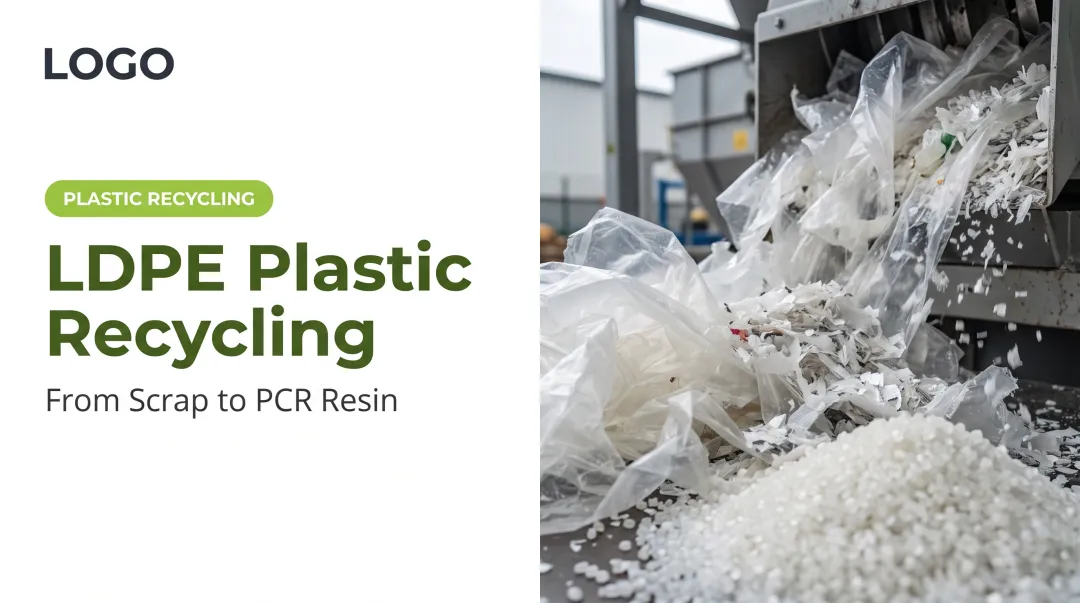
LDPE's flexible, film-like form has historically been harder to recycle than HDPE. It clogs sorting equipment, doesn't separate cleanly on conveyor lines, and typically needs a dedicated collection stream rather than standard curbside pickup.

Is Polyethylene Recyclable and Eco-Friendly?
Yes, polyethylene is recyclable. But "recyclable" and "gets recycled by your local program" are two different claims, and manufacturers need to understand the difference.
The Association of Plastic Recyclers recommends that PE film packaging contain at least 90% PE and PE copolymers by weight to remain fully compatible with mechanical recycling. Fall short of that threshold, and the material becomes a contamination risk rather than a recycling candidate.
The Environmental Case
When recycled PE content replaces virgin resin, the impact is measurable. A pellet-to-pellet lifecycle assessment from APR and Franklin Associates found that 100% post-consumer recycled HDPE uses 88% less total energy than 100% virgin HDPE. The same study reported 71% lower global-warming potential and 59% lower water use, per APR's 2020 LCA report.
Those figures turn a sustainability pledge into something a manufacturer can stand behind, provided the recycled content is verified, not just claimed.
Why Recyclability Still Has Limits
A resin's recyclability also depends on:
- Facility infrastructure — not every MRF processes every plastic type
- Contamination levels — dirty or mixed bales get downgraded fast
- End-market demand — recyclers need buyers for the pelletized resin, or the material has nowhere to go
How Polyethylene Is Recycled: The Step-by-Step Process
PE recycling works as a reverse supply chain. Scrap moves from consumer or industrial collection points through sorting and reprocessing, then back into new products as resin. Here's how that actually happens.
Step 1: Collection & Sorting
PE scrap arrives from manufacturers, haulers, or material recovery facilities in mixed loads. Before it's usable, it has to be separated by resin type (HDPE vs. LDPE) and often by color, using a combination of optical scanning and manual quality checks. Sorted material is then compressed into bales, typically 1,000 to 1,500 pounds each, for transport to a reprocessing facility.
This is also where the recyclable-versus-recycled gap becomes concrete. Scrap only moves forward if a buyer will take it and reprocess it.
PPP, LLC purchases qualifying HDPE and LDPE scrap from manufacturers, processors, converters, and recycling partners—both post-industrial material and post-consumer sources such as bottles and packaging. That network is what turns "technically recyclable" scrap into resin that re-enters manufacturing.
Step 2: Grinding, Washing & Float-Sink Separation
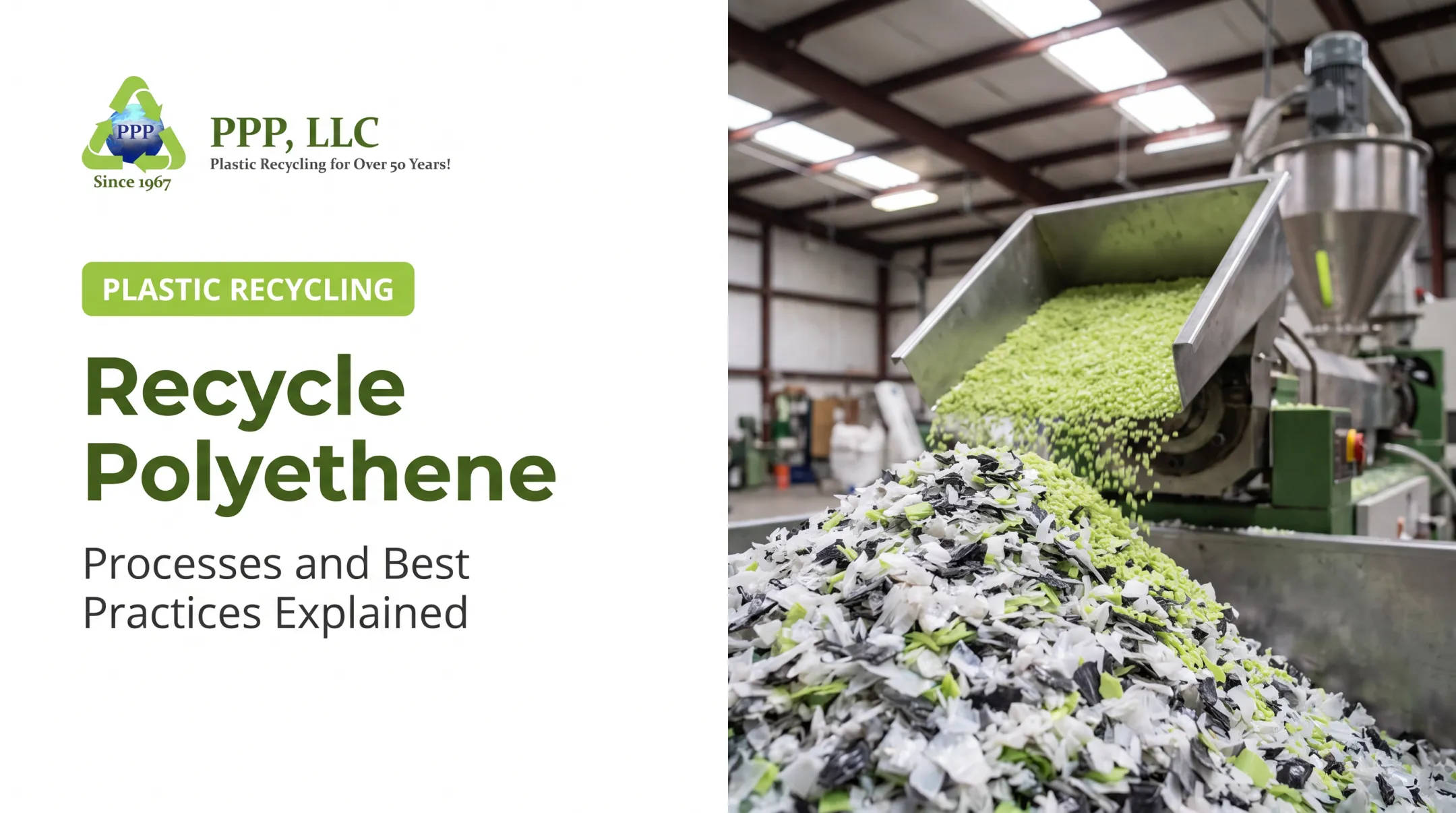
Once baled PE reaches a reclaimer, the bales are opened and any remaining glass or metal is pulled out. The material is then:
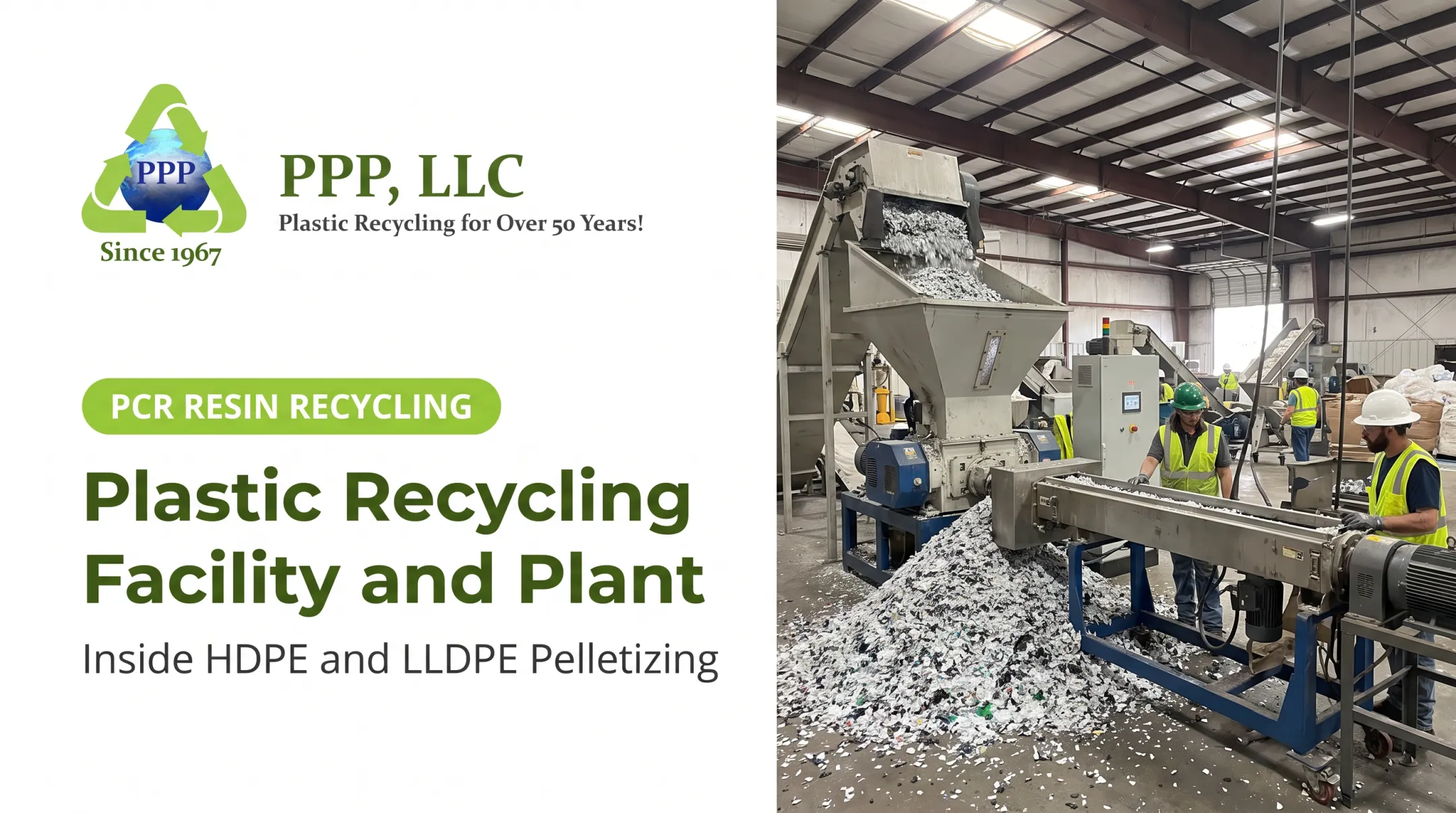
- Ground into flake with industrial shredding equipment
- Washed in hot water with detergent to strip labels, adhesive, and dirt
- Separated by density in float-sink tanks, where plastics behave differently in water
- Rinsed and dried before melting
Contamination gets caught (or missed) right here. A single mislabeled load of PVC or polystyrene mixed into a PE bale can compromise an entire batch.
Step 3: Melting, Pelletizing & Reintroduction to Manufacturing
Clean, dry flake is melted in an extruder, filtered to remove any remaining solids, and formed into pellets. Those pellets become the PCR resin that manufacturers buy to replace virgin plastic in new products.
PPP, LLC has ground and pelletized HDPE and LDPE since 1967, running sourcing, shredding, washing, extrusion, and pelletizing under one roof. Manufacturers can also use toll processing: send in owned scrap, keep title to the material, and get PCR resin back without building in-house recycling capacity.
Finished resin is customized for size, shape, color, and performance so it matches what the production line needs.

Which Types of Plastic Cannot Be Recycled?
Not every plastic belongs in a PE recycling stream, and mixing the wrong material into a PE bale can tank its resale value. The usual suspects:
- PVC (#3): Trace amounts can release chlorine compounds that ruin an entire PE batch (APR PVC design guidance)
- Polystyrene (#6), including expanded foam: Most recyclers won't take it, and acceptance varies heavily by facility
- Multi-layer or multi-material packaging: Bonded incompatible layers can't be separated economically, so most of these packages have no mainstream recycling path
PET (#1) and PP (#5) can recycle in their own streams, but they contaminate PE bales the same way. Keep them out.
Practical guidance for manufacturers: Keep PE scrap separated by resin type from the moment it's generated, and never mix it with non-PE materials. A clean, single-resin bale holds its value. A contaminated one gets downgraded or rejected outright—lost revenue on scrap that could have sold as resin.
Recycled PE Applications, PCR Certification & California Compliance
Recycled PE, often called PCR resin, comes from cleaned and reprocessed post-consumer HDPE or LDPE flake, melted down and pelletized for reuse. That feedstock already lived as a bottle, bag, or packaging before it returns to manufacturing for a second use.
Where Recycled PE Ends Up
PPP, LLC supplies PCR resin into several manufacturing categories, including:
- Bag manufacturing (grocery, retail, and industrial)
- Food and pharmaceutical packaging
- Electronics packaging
- General retail packaging
- Irrigation and agricultural components
PCR Certification: Why It Matters
Third-party PCR certification verifies chain of custody and recycled-content percentages through independent audit, not self-reporting. APR's certification standards require roughly 12 months of tracked input and output records before approval. PPP, LLC holds PCR certification with quarterly reviews and annual re-certification, plus APR membership. Manufacturers get a documented paper trail instead of a vague sustainability claim.
California's Recycling Laws: What Manufacturers Need to Know
| Law | What It Requires |
|---|---|
| SB 270 | Historically required 20-40% PCR in reusable plastic film grocery bags; those specific carryout-bag requirements were repealed effective January 1, 2026 |
| SB 54 | Sets packaging source-reduction targets (10% by 2027, rising to 25% by 2032) and recycling-rate targets (30% by 2028, rising to 65% by 2032), enforced with civil penalties up to $50,000 per day per violation |
| SB 343 | Restricts use of the chasing-arrows recyclability symbol unless packaging meets statutory recyclability criteria, with compliance required by October 4, 2026 |
| RPPC Law | Requires rigid plastic packaging containers to contain at least 25% post-consumer content, or meet an equivalent compliance path |
Manufacturers sourcing PE resin in California need documentation to back these claims. Working with a certified recycler like PPP, LLC, verified through PCR certification and APR membership, gives manufacturers audit-ready records that hold up if regulators come asking.

Frequently Asked Questions
Is PE plastic recyclable and eco-friendly?
Yes. HDPE and LDPE are among the most recyclable plastics when properly sorted, cutting landfill volume and reducing demand for virgin resin. The environmental benefit depends heavily on clean sorting and contamination control.
Which types of plastic cannot be recycled?
PVC, polystyrene, and multi-layer or multi-material packaging are commonly excluded from PE recycling streams because they contaminate batches or lack an economical separation method.
What is recycled PE material made of?
Recycled PE comes from cleaned, reprocessed post-consumer HDPE or LDPE flake that's melted down and formed into pellets, ready for reuse in new manufacturing.
What's the difference between recycling HDPE and LDPE?
HDPE's rigid shape makes it easier to sort and recycle at scale through standard MRF equipment. LDPE's flexible film form requires specialized collection and processing infrastructure.
What does PCR certification mean for a recycled resin supplier?
It means an independent third party has verified the supplier's chain of custody and recycled-content claims, giving manufacturers documented proof rather than a marketing statement.
Can plastic bags and films be recycled curbside?
Usually not. Most curbside programs reject flexible PE films and bags. Per CalRecycle's 2025 material characterization study, film collection reaches only 28-29% of residents versus 92-99% for rigid HDPE, so use designated drop-off or specialized programs instead.