
For manufacturers, packaging producers, and brands trying to meet sustainability goals or California's recycled-content laws, "recycling" isn't a marketing checkbox. It's a mechanical process with real quality variables. This article breaks down how PE recycling actually works, what affects output quality, and where the common misconceptions trip people up.
Key Takeaways
- Mechanical PE recycling turns HDPE/LDPE scrap into PCR resin through grinding, washing, and pelletizing.
- HDPE and LDPE require separate processing streams due to differing densities and melting behavior.
- Input contamination is the single biggest driver of final resin quality.
- California SB 54 is enforceable now; AB 478 stalled, and SB 270 bag rules were superseded.
- A PCR-certified, APR-member processor helps manufacturers hit both resin quality specs and compliance targets.
What Is the Polyethylene Recycling Process?
PE recycling is the mechanical conversion of post-consumer or post-industrial HDPE and LDPE scrap into recycled resin, sold as flake or pellets for reuse in manufacturing. The Association of Plastic Recyclers (APR) defines mechanical recycling as sorting, cleaning, shredding, and melting plastic without altering its underlying chemical structure.
The process produces PCR (post-consumer recycled) resin that must hit defined specs for:
- Pellet size and shape
- Color consistency
- Melt performance suitable for the intended application
PE isn't interchangeable with "plastic" as a category. PET, PP, and PVC each melt at different temperatures and have different densities, so they run through entirely separate recycling streams.
HDPE typically has a density of 0.94–0.97 g/cm³, meaning clean HDPE floats in water — a property recyclers rely on later in the process. Mixing resin types at any stage compromises the final product.
PPP, LLC has focused specifically on HDPE and LDPE processing since 1967, producing PCR resin for manufacturers in bag production, packaging, and irrigation components rather than trying to be a general plastics recycler.
Why the PE Recycling Process Is Used in Manufacturing
Manufacturers don't adopt PE recycling out of goodwill alone. There are concrete operational reasons:
- Landfill diversion — with HDPE recovery under 11% nationally, there's significant untapped material sitting in the waste stream.
- Lower carbon footprint — an APR/Franklin Associates life-cycle study found recycled HDPE cut total energy use by 88% and emissions by 71% versus virgin resin.
- Cost stability — recycled resin isn't automatically cheaper—NIST notes it can match or run up to twice virgin pricing—so the value is often supply security and compliance, not a discount.
Those energy and emissions savings are measured from collection through reclaimer processing, not final product conversion.
What Goes Wrong Without Proper Recycling Practices
Those gains only hold when sorting and washing are disciplined. Without that, manufacturers end up with:
- Inconsistent melt flow between batches
- Odor and discoloration from residual contaminants
- Unmelts or gels that weaken finished parts
The Regulatory Layer
Quality defects aren't the only exposure. California's recycled-content landscape is more nuanced than it's often presented:
| Law | Current Status | Practical Impact |
|---|---|---|
| SB 54 | Enacted (2022), phased through 2032 | Producers need PRO participation and recycled-content compliance |
| SB 270 | Original bag rules superseded by SB 1053 | Historical, not a current PCR mandate |
| AB 478 | Stalled in committee | Never became law; don't treat as active |
Working with a PCR-certified, APR-member facility helps manufacturers source verified HDPE/LDPE resin that meets performance needs and the compliance framework that applies to their product category.
How the Polyethylene Recycling Process Works (Conceptual Flow)
PE scrap moves through six stages. Feedstock ranges from curbside HDPE bottles to post-industrial LDPE film scrap from converters.
- Collection
- Sorting
- Size reduction
- Cleaning
- Separation
- Pelletizing

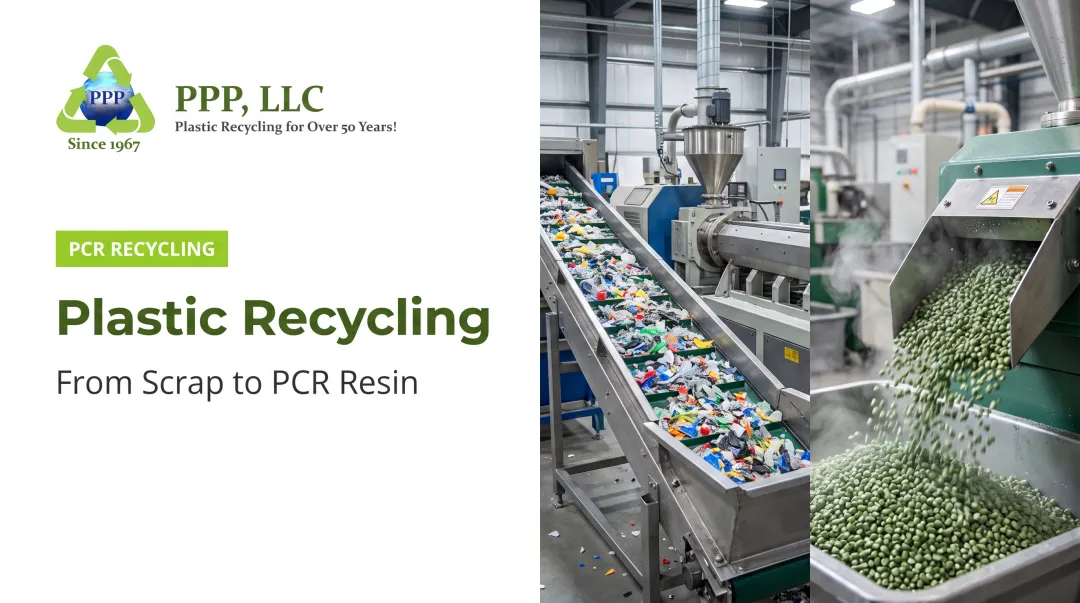
On the shop floor, those stages usually group into three phases. The core work sits in the middle: grind to flake, hot-water wash, float-sink to pull denser contaminants, then melt and extrude into pellets.
Facilities steer quality with calibrated optical sorters, screen sizes, and wash temperatures. Exact settings vary by processor and feedstock. Contaminated, mixed scrap becomes uniform resin ready for manufacturing.
Step 1: Collection and Sorting
PE scrap arrives from curbside programs, industrial scrap generators, or drop-off centers. At the facility, it's sorted by resin type and color using a mix of optical sorters and manual quality checks. Natural HDPE is separated from colored HDPE using near-infrared sortation — critical because color contamination ruins a clear-resin batch instantly.
Step 2: Size Reduction and Washing
Sorted PE is shredded into flake, then washed in hot water with detergent to strip labels, adhesive residue, and food or product residue. This step protects everything downstream: poor washing here means gels and odor problems at extrusion.
Step 3: Separation, Melting, and Pelletizing
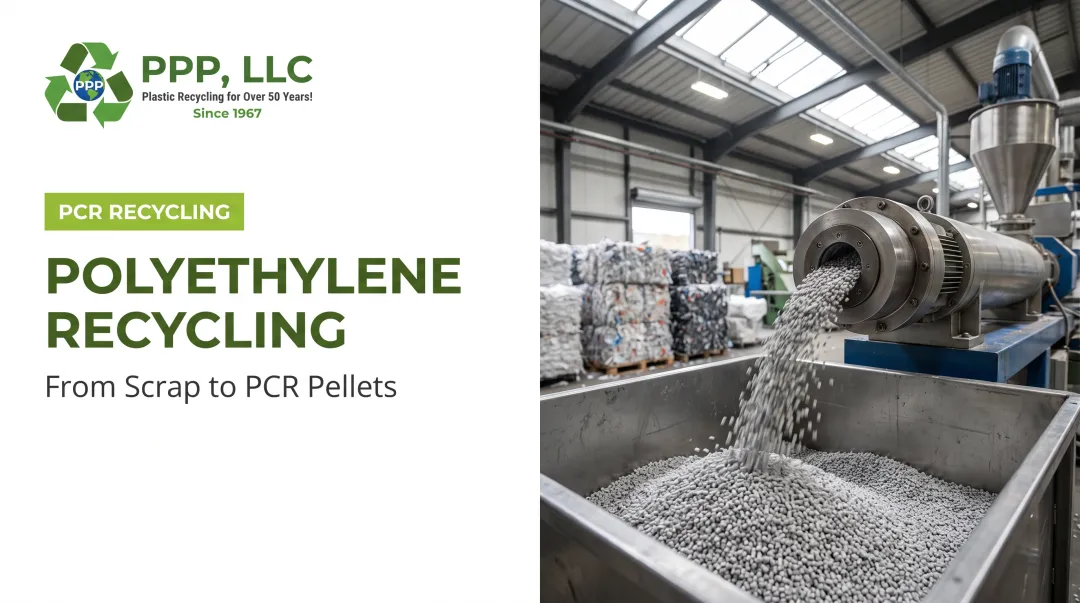
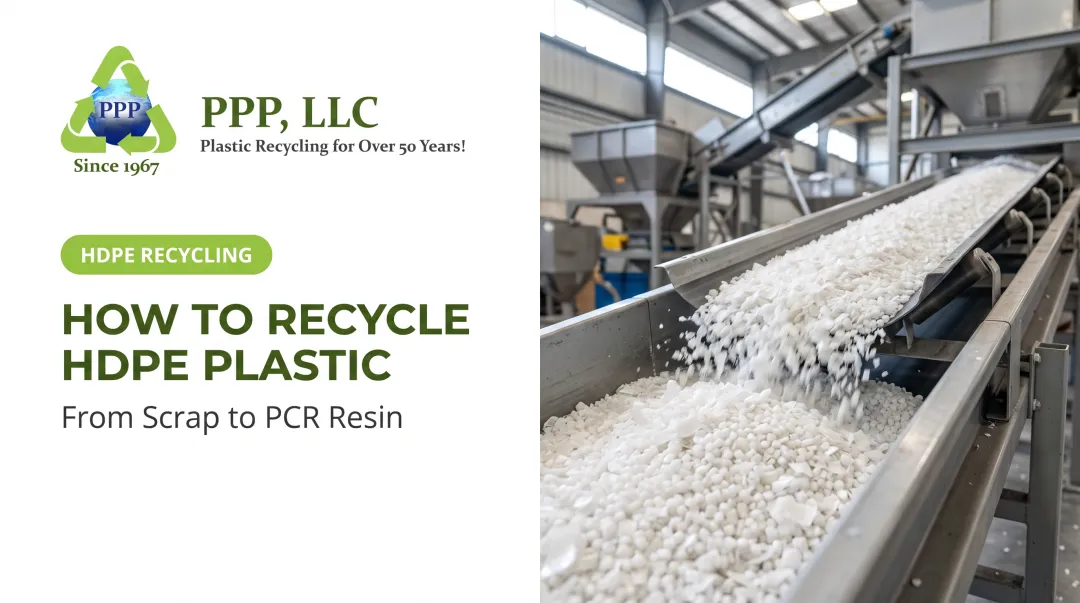
Flake goes into a float-sink tank. Clean PE floats; denser contaminants sink and get removed. From there, material is dried, melted in an extruder, filtered to catch remaining solids, and formed into pellets ready for resale or reuse.

PPP, LLC follows this same sequence for toll-processed customer scrap and for resin it sells directly. The company converts HDPE, LDPE, and LLDPE into pellets or granules that can be specified by size, shape, color, and finish for packaging, bags, and irrigation components.
Key Factors That Affect PE Recycling Quality
Several variables determine whether output resin meets spec:
- Input quality — contamination from food residue, labels, or mixed resin types is the top cause of quality loss.
- Operating conditions — wash temperature, drying time, and extrusion temperature affect consistency; processors set these by feedstock and product rather than a universal benchmark.
- Equipment dependencies — optical sorters, grinders, and float-sink tanks all need to be available and properly calibrated.
- Scale and throughput — larger facilities can run higher volumes, but only with consistent bale quality from suppliers.
- Regulatory constraints — PCR certification standards and state recycled-content laws define what qualifies as certified recycled resin.
Per APR design guidance, PE flexible packaging with more than 90% PE by weight processes cleanly. Structures at 80–90% PE can present technical challenges. Below 80%, yield and quality both suffer.

Common Issues, Misconceptions, and Limitations
"All PE products belong in curbside bins." Not true. A widely cited 2012 study found only 10.8% of the U.S. population had curbside access to bag and film recycling.
Rigid HDPE containers are commonly accepted; flexible film usually isn't. Film tangles sorting equipment at the materials recovery facility (MRF), so it belongs in store drop-off programs, not curbside bins.
"Recyclable" and "actually recycled" aren't the same thing. A bag might carry a recycling symbol, yet still require a dedicated drop-off program rather than a curbside bin.
"Recycled PE performs identically to virgin resin." Mostly true for early cycles, but not indefinitely. A 2024 Nature Communications study found that repeated extrusion cycles gradually increase viscosity and cause chain scission.
Quality can drift after multiple reprocessing rounds. Well-controlled HDPE can still withstand many cycles before that shift becomes significant.
"All PE scrap is worth recycling." Not always. Heavily contaminated or mixed-material scrap often isn't economical to sort and process.
Collection and sorting costs frequently exceed the resale value of low-quality material. Clean, well-sorted feedstock commands better pricing from processors for that reason.
Frequently Asked Questions
Can polyethylene be recycled?
Yes. Both HDPE and LDPE are widely recyclable through mechanical processing. Flexible LDPE films typically need separate drop-off collection rather than curbside bins.
What is the difference between HDPE and LDPE recycling?
Both follow the same collection-grind-wash-pelletize sequence. HDPE is rigid and processes more easily; LDPE is soft, more flexible, and more prone to contamination during collection.
What products are made from recycled polyethylene?
Common outputs include plastic lumber, retail and grocery bags, piping, rigid containers, and packaging films used across food, pharmaceutical, and electronics applications.
Why can't all polyethylene be recycled curbside?
Flexible films tangle sorting equipment at material recovery facilities. Most programs require film to go through dedicated drop-off or industrial collection channels instead.
How is recycled PE resin certified for quality?
PCR certification and APR membership provide third-party, chain-of-custody verification. This confirms recycled content actually comes from post-consumer sources and meets defined quality standards.
Does recycling polyethylene really reduce environmental impact?
Yes. It cuts landfill waste, lowers carbon emissions, and reduces reliance on virgin petroleum-based plastic compared with manufacturing from raw feedstock.