
Introduction
Milk jugs, water pipes, detergent bottles, playground equipment. High-density polyethylene (HDPE) shows up in more everyday products than most people realize, and it's one of the most recycled plastics in the U.S.
The EPA reported a 29.3% recycling rate for natural HDPE bottles in 2018, the latest year with national data.
That recyclability creates a real decision point for manufacturers: virgin resin or recycled? Each path comes with different cost structures, quality specs, and regulatory obligations, especially as states like California tighten recycled-content rules.
This guide breaks down what HDPE resin actually is, its key properties, how it compares to LDPE and LLDPE, where it's used, and how recycled HDPE stacks up against virgin material.
Key Takeaways
- HDPE is a linear, low-branching polyethylene valued for rigidity, chemical resistance, and recyclability (resin code #2)
- HDPE melts at roughly 120–140°C, with density between 0.93 and 0.97 g/cm³
- Bottles, pipes, containers, and industrial packaging account for most HDPE use
- Recycled (PCR) HDPE can match virgin material's performance while cutting energy use and emissions
- California's SB 54 and SB 343 are reshaping recycled-content and labeling requirements for HDPE products
What Is HDPE Resin?
HDPE is a polymer of ethylene, meaning thousands of ethylene molecules link together into long chains. Its chemical formula is written as (C2H4)n, and its defining trait is structure: HDPE forms mostly linear chains with very little branching, which lets the molecules pack tightly together.
That tight packing is what separates HDPE from its polyethylene cousins. LDPE has heavy branching that keeps chains loosely arranged, while LLDPE sits in between with short, uniform branches. HDPE's linearity is why it earns resin identification code #2 and behaves so differently from its softer relatives.
Where Virgin HDPE Comes From
Ethylene, the building block of HDPE, doesn't occur naturally in usable form. It's produced by cracking either:
- Natural gas liquids (ethane) — heated at high temperatures to break molecules apart
- Crude oil-derived naphtha — processed through similar steam-cracking methods
Once ethylene is available, manufacturers polymerize it using one of two industrial methods:
- Slurry polymerization — catalyst and polymer are suspended in a liquid diluent alongside monomer and hydrogen, operating at comparatively mild pressure and temperature
- Gas phase polymerization — ethylene reacts inside a fluidized- or stirred-bed reactor without a liquid medium
How Recycled HDPE Resin Is Made
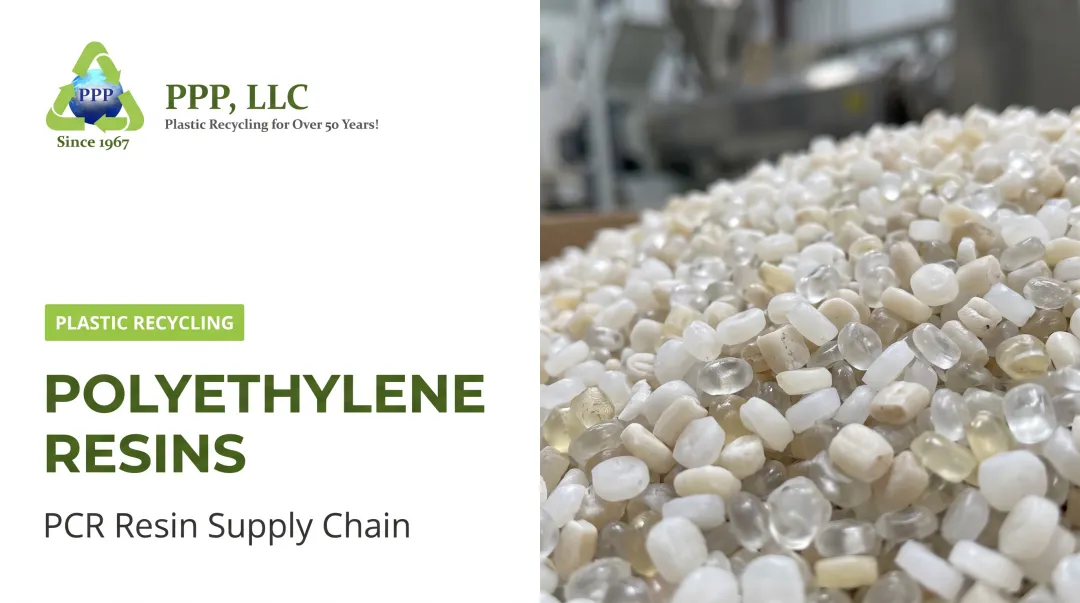
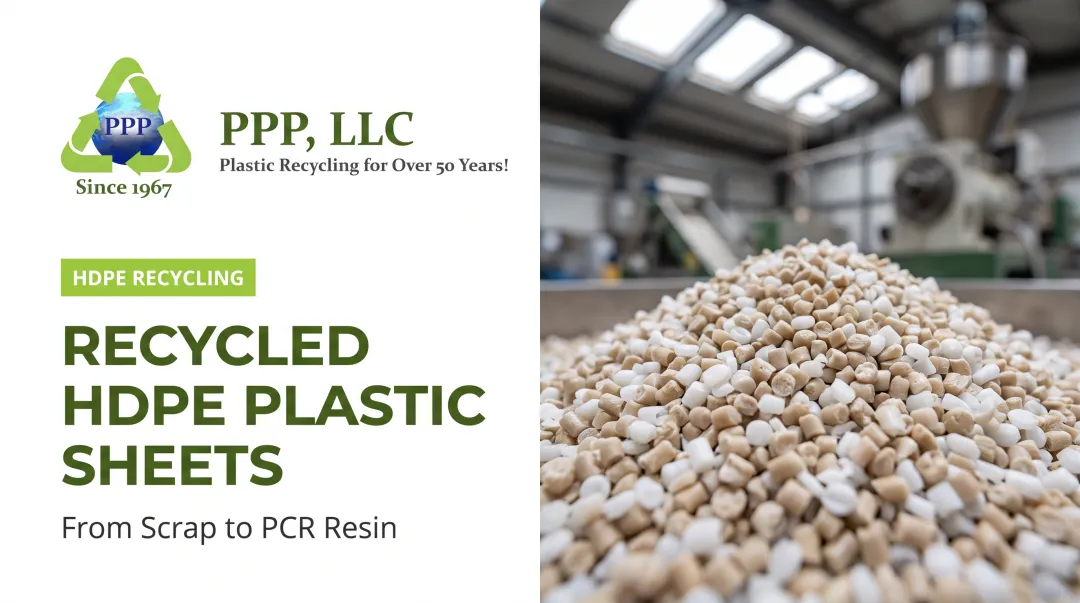
Recycled HDPE skips the petrochemical feedstock entirely. Processors turn post-consumer scrap such as water bottles, beverage containers, and packaging into usable resin through sorting, grinding, washing, melting, and pelletizing.
PPP's process follows that path:
- Source and sort post-consumer and post-industrial HDPE
- Grind it into consistent feedstock
- Clean out contaminants
- Melt and extrude pellets for the next manufacturer's supply chain

Key Properties and Characteristics of HDPE Resin
HDPE's usefulness comes down to a handful of measurable properties that make it both durable and workable.
Melting point and density. HDPE typically melts between 120-140°C, noticeably higher than LDPE's softer range. Density runs 0.93-0.97 g/cm³, and that figure drives performance: higher density means tighter molecular packing, which translates directly into more rigidity and strength. It's why HDPE holds its shape in a detergent bottle while LDPE film stretches and flexes.
Chemical resistance. HDPE stands up well to most solvents, dilute acids, and alkalis, which is why it's a go-to for chemical containers and piping. Its one notable weakness: hydrocarbons can degrade it over time, so it's not the right choice for every fuel-contact application.
Mechanical performance. A few properties manufacturers count on:
- High tensile strength, even in cold conditions
- Good low-temperature toughness without becoming brittle
- Reliable performance across a wide service temperature window, commonly cited as roughly -50°C to +60°C depending on grade
Other useful traits:
- Excellent electrical insulation properties
- Very low water absorption
- Eligible for food-contact use when formulated to meet 21 CFR 177.1520 requirements — not every HDPE grade automatically qualifies
Where HDPE Falls Short
HDPE is prone to environmental stress cracking, meaning it can fail under sustained stress well below its rated tensile strength, particularly around sharp corners or under load. It's also UV-sensitive without stabilizer additives, which is why outdoor products need UV inhibitors mixed in during processing.
The Three Main Types of Polyethylene: HDPE vs LDPE vs LLDPE
Polyethylene isn't one material; it's a family, and the three commercial workhorses are classified by density and branching structure.
- HDPE: linear chains, minimal branching, high density, rigid. Used for bottles, pipes, and containers.
- LDPE: heavily branched chains that prevent tight packing, lower density, flexible. Used for films, bags, and squeezable packaging.
- LLDPE: linear backbone with short, uniform branches, strong puncture and impact resistance. Used for stretch films and heavy-duty bags.
Lab comparisons of these three resins show clear structural differences:
| Resin | Density | Crystallinity | Common Use |
|---|---|---|---|
| HDPE | 0.954 g/cm³ | 51.17% | Bottles, pipe, containers |
| LLDPE | 0.922 g/cm³ | 39.45% | Stretch film, bags |
| LDPE | 0.918 g/cm³ | 38.73% | Packaging film, squeeze bottles |
Those numbers reflect one lab's specific samples rather than universal grade specs, but the pattern holds industry-wide: HDPE packs the tightest, LLDPE lands just above LDPE.
Niche variants like UHMWPE (ultra-high molecular weight) and PEX (cross-linked) exist for specialty applications, but HDPE, LDPE, and LLDPE account for the vast majority of polyethylene resin sold globally.

Common Applications and Industries Using HDPE Resin
HDPE's rigidity and chemical resistance make it a default choice across three broad categories.
Packaging. Milk and juice bottles, detergent containers, bottle caps, crates, and industrial drums all lean on HDPE's strength-to-weight ratio and resistance to household chemicals.
Pipe and infrastructure. Water, gas, and irrigation piping rely on HDPE's durability and chemical resistance. The Plastics Pipe Institute notes HDPE has supported municipal and industrial water systems for more than 75 years. It is also a standard material for drip irrigation lines in agriculture.
Consumer and industrial goods. Garbage containers, housewares, agricultural films, ropes, and nets are common HDPE applications.
PPP's recycled HDPE pellets feed several of these categories directly, including:
- Bag manufacturing (grocery, retail, and industrial bags)
- Food and pharmaceutical packaging
- Electronics packaging
- Irrigation systems and agricultural components
Virgin vs Recycled (PCR) HDPE: Production and Sustainability
Virgin HDPE starts with fresh ethylene, polymerized through slurry or gas-phase methods described earlier. Recycled, or post-consumer recycled (PCR), HDPE starts with material that's already been through a first life as a bottle, jug, or container.
The recycled path follows a clear sequence:
- Collect post-consumer scrap
- Sort by resin type
- Grind the material down
- Wash out contaminants
- Pelletize the clean output into resin ready for a new production run
PPP, LLC has run this process since 1967. As a PCR-certified, APR-member facility, it produces recycled HDPE resin engineered to match virgin material across size, shape, color, finish, and performance specifications. It also offers toll processing for manufacturers who want their own scrap converted into usable resin without transferring ownership.
Why the Environmental Math Favors Recycled
A cradle-to-gate life cycle assessment from APR and Franklin Associates found that PCR HDPE used 88% less total energy and produced 71% lower global-warming potential than virgin HDPE, based on a cut-off allocation model covering collection through resin production.
For manufacturers, that translates into concrete advantages:
- Reduced carbon footprint tied to sourcing and production
- Less dependence on non-renewable petrochemical feedstocks
- Lower landfill contribution from diverted post-consumer scrap
- Potential cost savings, particularly as recycled-content mandates expand
- A credible sustainability claim for environmentally conscious brand positioning

HDPE Recycling Codes and Regulatory Compliance
HDPE carries resin identification code #2, assigned under ASTM D7611. That code identifies the resin type, but an RIC alone doesn't guarantee a product is recyclable in every market. It simply tells processors what material they're handling.
California has turned that distinction into enforceable policy:
- SB 54 sets packaging recycling targets of 30% by 2028, 40% by 2030, and 65% by 2032, plus source reduction and producer responsibility rules
- SB 343 restricts chasing-arrows recycling symbols to materials that are actually collected, sorted, and reprocessed into new products at meaningful rates in California
- AB 478 proposed postconsumer recycled-content minimums for thermoform plastic containers, a signal of where broader HDPE-adjacent packaging rules may be heading
Why Sourcing From a Certified Recycler Matters
Given this regulatory direction, sourcing recycled HDPE from a PCR-certified, APR-member recycler is practical compliance risk management. PPP maintains PCR certification through quarterly reviews and annual re-certification, giving manufacturers a documented, consistent supply chain for evolving compliance requirements.
Frequently Asked Questions
Where does polyethylene come from?
Polyethylene comes from polymerizing ethylene gas, which is produced by cracking either natural gas liquids (ethane) or crude oil-derived naphtha at high temperatures.
What are the three types of polyethylene?
The three primary types are HDPE, LDPE, and LLDPE, distinguished mainly by density and branching structure. HDPE is the most linear and rigid; LDPE is highly branched and flexible; LLDPE sits between them, offering strength with more flexibility than HDPE.
Is polyethylene just plastic?
Polyethylene is one specific family of thermoplastics within the broader plastics category. It's valued for its versatility, chemical resistance, and recyclability compared to other plastic types.
What is HDPE resin used for?
HDPE resin is commonly used for bottles, water and gas pipes, containers, crates, and industrial packaging, thanks to its rigidity and chemical resistance.
Is HDPE recyclable?
Yes. HDPE (resin code #2) is one of the most widely recycled plastics and can be reprocessed into PCR resin multiple times without significant quality loss.
What is the difference between virgin and recycled (PCR) HDPE resin?
Virgin HDPE is made from new ethylene feedstock, while PCR HDPE comes from post-consumer scrap that's been sorted, cleaned, and reprocessed. When properly processed, PCR resin can match virgin material on key performance specs.