
If you're a manufacturer, recycler, or eco-conscious business sourcing recycled resin, understanding this process matters. It affects product quality, regulatory compliance, and how "sustainable" your supply chain really is.
Pelletizing gets mentioned constantly in recycling conversations, but rarely explained at the operational level. This guide breaks down how it works, what affects pellet quality, and where the process actually gets used.
TL;DR
- Pelletizing converts plastic scrap or melt into uniform pellets for manufacturing reuse
- Six stages—feeding, melting, extrusion, cutting, cooling, and drying—produce consistent pellets
- Strand, water-ring, and underwater cutting match different resins, including HDPE and LDPE
- Feedstock cleanliness, moisture control, and equipment precision drive pellet quality
- PCR-certified recyclers like PPP, LLC ensure pellets meet manufacturing specs and regulatory requirements
What Is the Plastic Pelletizing Process?
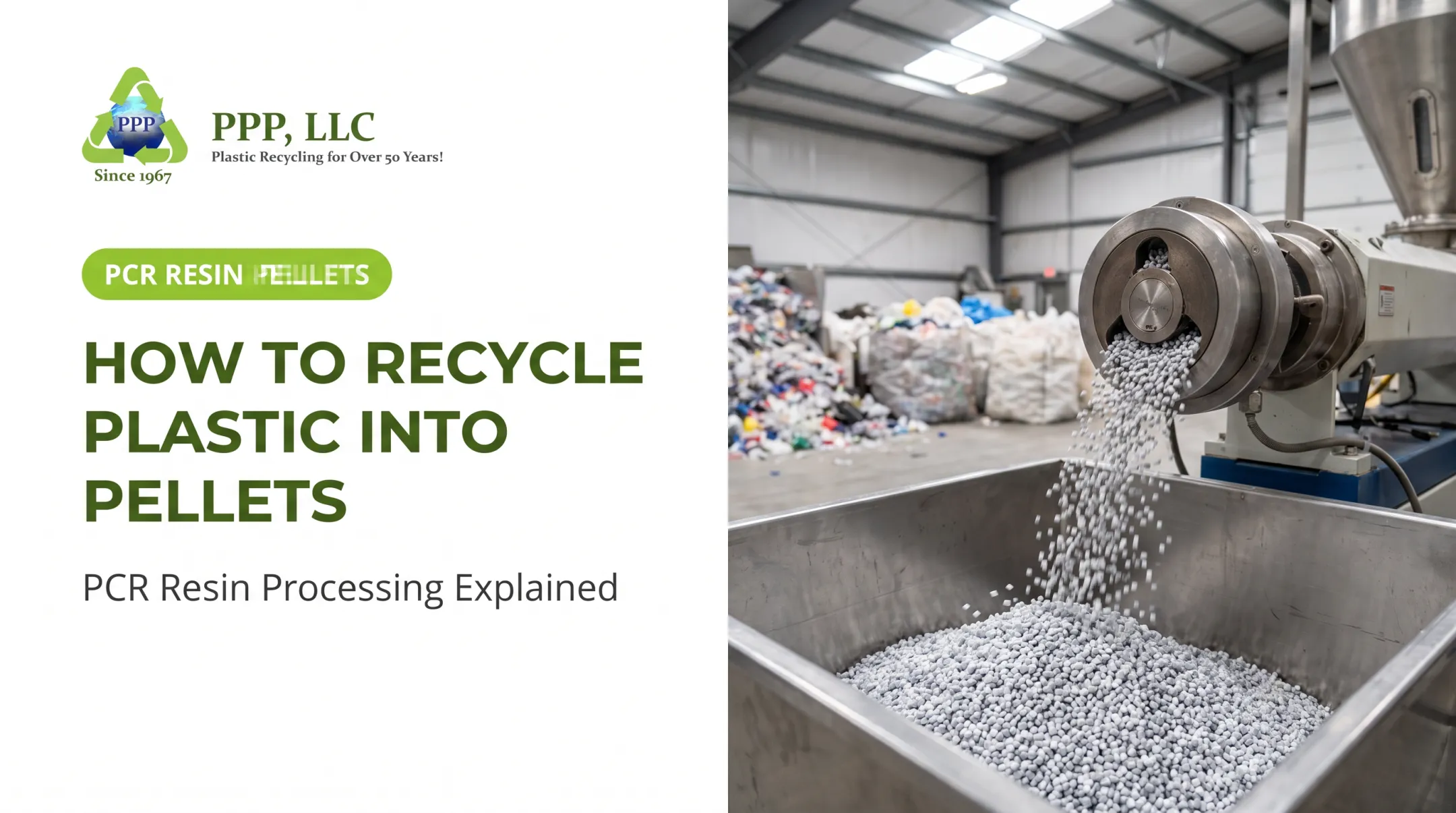
Pelletizing is the process of melting and reforming plastic scrap or resin into small, uniform pellets through extrusion and cutting. The result: consistent, flowable pellets that feed reliably into injection molding or extrusion equipment.
Pelletizing is easy to mix up with related steps. Here's the distinction:
- Grinding — shreds plastic into flake or regrind. No melting involved.
- Extrusion (alone) — creates continuous shapes (sheets, pipes). Not discrete pellets.
- Pelletizing — melts plastic and cuts it into small, uniform units for reuse.
Grinding usually happens before pelletizing, not instead of it. The Association of Plastic Recyclers describes this exact sequence: plastic is sorted, ground into flake, then melted, filtered, and pelletized.

Why the Pelletizing Process Is Used in Plastic Recycling and Manufacturing
Manufacturers running injection molding or extrusion lines need consistent particle size, stable melt flow, and controlled moisture content. Pelletizing delivers all three in a way loose flake or regrind can't.
Regrind tends to have lower bulk density and a higher angle of repose than pellets, which affects how it flows into a feed throat (Plastics Technology, 2019). In practice, that means:
- Uneven feeding into the extruder
- Inconsistent melt temperatures across a production run
- Batch-to-batch variability that drives product defects
Most extrusion setups can handle 10–20% reclaim without major equipment changes; specialized screw designs can push that to 100% ground recycle. But that flexibility depends heavily on feedstock form. Pellets remove much of the guesswork.
Where Compliance Fits In
Pelletizing recycled PE resin is no longer only a manufacturing convenience. In states like California, it ties directly to compliance frameworks:
- SB 54: extended producer responsibility for packaging and single-use plastic food service ware
- RPPC Law: rigid plastic packaging containers can satisfy requirements through a 25% postconsumer material route
- SB 343: restricts recyclability labeling unless statutory criteria are met
AB 478 died in committee in 2022, and SB 270's bag requirements are no longer in effect following SB 1053. Older references to either can be misleading.
PPP, LLC's PCR certification and APR membership reflect ongoing alignment with these evolving standards for HDPE and LDPE pelletizing.
How the Plastic Pelletizing Process Works (Conceptual Flow)
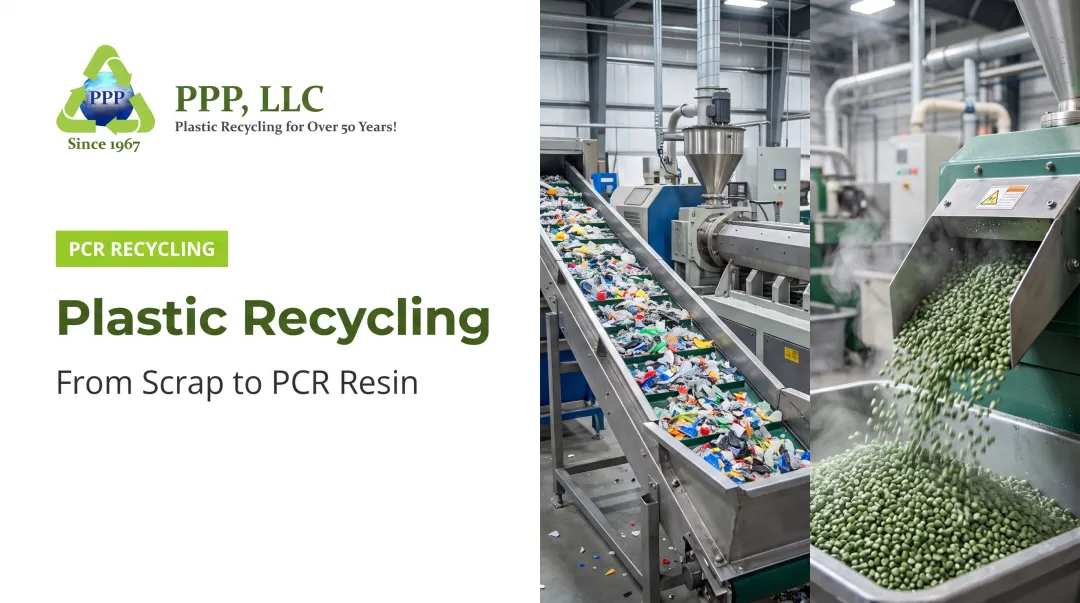
Operators feed raw plastic into an extruder, melt it, force it through a die, cut it into pellets, then cool and dry them. Sorted scrap, flakes, or regrind — commonly HDPE and LDPE — are the typical inputs.
The core transformation happens through heat and mechanical shear from the screw, which pushes molten plastic through a shaped die. Operators control the outcome through:
- Temperature zones along the barrel
- Screw speed
- Cutting speed at the die
- Cooling method (air or water)
Irregular scrap becomes uniform, flowable pellets ready for remanufacturing.

Step 1: Feeding and Size Reduction
Operators shred or grind sorted plastic scrap into a consistent flake size before it enters the extruder. Uneven flakes melt at different rates, so consistent sizing here prevents weak spots and throughput swings later in the line.
Step 2: Melting and Extrusion
The screw and barrel heat and homogenize the plastic into a molten stream. Most systems pass that stream through filtration screens to catch contaminants before they reach the die. The Association of Plastic Recyclers (APR) treats this filtration step as standard in flake-to-pellet processing.
Step 3: Cutting and Pellet Formation
Molten plastic exits through a die and is cut with one of three methods:
| Method | How it works | Best suited for |
|---|---|---|
| Strand | Cooled in a water bath, then cut into cylinders | General-purpose resins |
| Water-ring | Cut at the die face, cooled in a tangential water ring | High-melt-strength polyolefins |
| Underwater | Cut underwater at the die, producing spherical pellets | High-throughput lines |

According to Plastics Technology (2019), the right method depends on resin type and line throughput.
Step 4: Cooling and Drying
Air or water cools the pellets, then dryers remove residual moisture before storage and shipping. Skipping thorough drying can undo quality gains made earlier in the process.
Where the Pelletizing Process Is Applied
Pelletizing shows up at recycling facilities converting post-consumer HDPE and LDPE scrap back into usable resin. It's the final step in a material's recycling lifecycle — the point where scrap officially becomes manufacturing input again.
Common triggers for a pelletizing run include:
- Bulk accumulation of packaging scrap
- Bag and film waste needing repurposing
- Industrial byproduct streams needing reintegration
This isn't a one-time treatment. At dedicated facilities, it's a continuous, recurring production process running on a set schedule, not triggered by isolated batches.
Scale and end markets vary by facility:
- Revolution: Wet-process line handling roughly 200 million lbs of PE annually, mostly agricultural film and commercial scrap (Resource Recycling, 2021)
- KW Plastics: White HDPE pellet capacity from mixed-color bales, aimed at blow-molded bottles and light-colored film
- PPP, LLC: Post-industrial and post-consumer HDPE/LDPE scrap—from water bottles, beverage containers, and packaging—returned as pellets for bag manufacturing, food and pharma packaging, and irrigation components
Key Factors That Affect Pellet Quality
Not all pellets are created equal, even from the same base resin. Quality comes down to a handful of controllable variables:
- Feedstock cleanliness and polymer separation: contamination drives inconsistent melt behavior and off-spec pellets
- Moisture content: excess moisture destabilizes the melt and can degrade certain polymers during extrusion
- Extruder temperature and screw speed consistency: fluctuations show up as pellet-to-pellet variability
- Cutting and cooling method matched to the material: strand systems suit different resins than water-ring or underwater setups
- Regulatory and certification benchmarks: PCR standards set a quality floor for recycled resin

APR's own evaluation protocol for PE film requires moisture and volatiles under 0.5% and mandates melt flow rate testing under ASTM D1238 or ISO 1133 (APR). That figure is a protocol benchmark for one evaluation, not a universal commercial spec, but it shows how tightly serious operations hold these variables.
PPP, LLC keeps those same controls under quarterly review and annual PCR re-certification so certified resin stays inside the quality and regulatory limits buyers expect.
Common Issues and Misconceptions
Buyers and processors often hit the same misconceptions when sourcing recycled pellets.
"All recycled pellets are the same quality." Far from it. Quality varies heavily based on feedstock cleanliness, process control, and equipment precision. Two batches of "recycled HDPE pellets" can perform completely differently in a mold.
"Pelletizing is just grinding or shredding." Grinding cuts material into flake. It doesn't melt anything. Pelletizing happens after grinding, when that flake gets melted, filtered, and reformed into pellets. They're sequential steps, not synonyms.
"Pellets and granules are the same thing." They're not:
- Granules are irregular, unmelted fragments (essentially another name for ground flake)
- Pellets are melt-processed and uniform in shape and size
"Pellet appearance tells you everything about quality." Color and shape are the easiest things to notice, but they're poor quality indicators on their own. Melt flow index and moisture content matter far more for how the pellet actually performs in production. A pellet can look perfect and still cause processing headaches.
Conclusion
Plastic pelletizing transforms scrap into standardized pellets through a sequence of melting, cutting, and cooling. That step is what makes recycled resin usable at manufacturing scale.
Understanding this process helps you evaluate recycled resin suppliers more critically and hit compliance targets with confidence rather than guesswork.
Working with a PCR-certified, APR-member recycler like PPP, LLC means you're sourcing pellets built on verified quality standards, not unverified claims. After more than 50 years processing HDPE and LDPE scrap, that experience shows up in consistent pellet quality and documentation you can trust.
Frequently Asked Questions
What is a pelletizing machine for plastic?
A plastic pelletizing machine melts, extrudes, cuts, and cools plastic scrap into uniform pellets for reuse. It typically includes an extruder, a die, a cutting mechanism, and a cooling/drying system.
What can plastic pellets be used for?
Pellets serve as feedstock for injection molding and extrusion processes. They're used to manufacture packaging, bags, and a wide range of consumer products.
What is the difference between pelleting and pelletizing?
Pelletizing melts plastic before forming it into pellets. Pelleting, a term used in other industries like agriculture, typically refers to compressing material into pellets without melting it.
What are plastic pellets called?
They're commonly known as resin pellets or nurdles. When derived from post-consumer material, they're often referred to as PCR resin.
Where can I buy plastic pellets?
Buy from certified recyclers or resin suppliers rather than unverified vendors. A PCR-certified, APR-member facility like PPP, LLC supplies verified-quality pellets with full material traceability.